

Capital Allowances for Small Business
Learn how capital allowances reduce taxable profit, which business assets qualify and how the rules differ for sole traders and limited companies.
Buying equipment, machinery or a business vehicle can be a significant expense. Capital allowances let you deduct some or all of the qualifying cost from your business profits before calculating tax. The relief available depends on the asset, your business structure and your accounting method.
If you are a sole trader using cash basis, you normally deduct qualifying equipment costs as business expenses instead. Capital allowances generally apply only to business cars under this method.
This guide explains the main allowances, including the Annual Investment Allowance, first-year allowances and writing-down allowances. Practical examples show how claims reduce taxable profit and what happens when you sell an asset or use it partly for personal purposes.
Disclosure: This content may contain affiliate links, which means if you click on them, I may get a commission (without any extra cost to you).

Capital Allowances at a Glance
- Tax relief: Deduct qualifying asset costs from taxable profit, rather than directly from your tax bill.
- Cash basis: Usually claim equipment as an expense. Capital allowances generally apply only to business cars.
- Annual Investment Allowance: Deduct qualifying costs up to £1 million for a 12-month accounting period. Cars are excluded.
- Writing-down allowances: Main rate 14%, with 12% announced from April 2027, subject to legislation. Special rate 6%.
- First-year allowances: Eligibility depends on the asset and business type. Full expensing is for companies only.
- Private use and disposals: Personal use can restrict your claim, and selling an asset may create a tax adjustment.
How Capital Allowances Reduce Taxable Profits
Capital allowances reduce the profit you pay tax on. The deduction depends on the qualifying cost and the allowance you claim.
For example, a business has £30,000 profit before capital allowances and buys qualifying machinery for £5,000. If it claims the full £5,000 under the Annual Investment Allowance, its taxable profit falls to £25,000.
This does not mean the business saves £5,000 in tax. If the whole deduction attracts tax relief at 20%, the tax saving is £1,000. The actual saving depends on the tax rates and circumstances of the business.

Cash Basis and Capital Allowances
If you are a sole trader or an eligible partnership using cash basis, you normally claim qualifying equipment costs as business expenses when you pay for them. This includes items such as computers, tools and machinery. Do not also claim capital allowances on the same cost.
Cars are the main exception. If you buy a business car, you generally claim capital allowances on its qualifying cost, unless you use simplified mileage expenses instead. You cannot claim both for the same vehicle.
Eligible sole traders can choose traditional accounting instead of cash basis. Under traditional accounting, qualifying equipment costs normally receive tax relief through capital allowances.
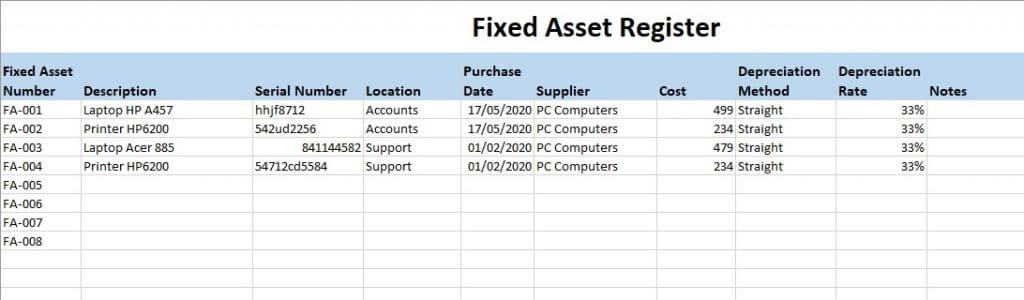
Use our free fixed asset register template to record asset purchases, costs and disposals. Keep a separate record of capital allowance claims, as tax values can differ from the accounting values in your register.
Read our self-employed allowable expenses guide for more about claiming equipment costs.
What Can You Claim Capital Allowances On?
Capital expenditure is money spent buying or improving fixed assets you expect to use in your business over several years, such as equipment, machinery or vehicles. Some of these costs qualify for capital allowances, but not all capital expenditure receives the same tax treatment.
Assets that qualify for plant and machinery allowances include:
- Machinery and tools
- Computers, printers and office furniture
- Vans and other commercial vehicles
- Business cars, which follow separate rules
- Certain fixtures and integral building features, such as electrical and heating systems
- Solar panels
- Qualifying building alterations needed to install plant or machinery
Not every asset qualifies for the same allowance. Cars do not qualify for the Annual Investment Allowance, and buying land or a building does not qualify for plant and machinery allowances. Some non-residential construction costs may qualify for the separate Structures and Buildings Allowance.
You generally need to own the asset, although special rules apply to hire purchase and some leases. Stock bought for resale and ordinary repairs follow business expense rules instead.
If you use cash basis, refer to the section above before claiming.
Types of Capital Allowances
The allowance you can claim depends on the asset, when you bought it and your business structure. Some allowances let you deduct the full qualifying cost in the year of purchase. Others spread the relief over several years.
The main options are explained below. An asset may qualify for more than one allowance, but you cannot claim relief twice on the same cost.
Annual Investment Allowance (AIA)
AIA lets eligible businesses deduct the full cost of qualifying plant and machinery from taxable profits, up to £1 million for a 12-month accounting period.
It covers many new and second-hand assets, including computers, machinery, vans and solar panels. Cars do not qualify.
You can claim less than the full amount. You may need to adjust the limit for shorter accounting periods or when sharing between related businesses.
Writing-Down Allowances (WDA)
Claim annual relief on the remaining tax value of qualifying costs not covered by upfront allowances:
- Main rate: 14% from April 2026.
- Special rate: 6%, including solar panels and certain building features.
A reduction to 12% is announced from 1 April 2027 for Corporation Tax and 6 April 2027 for Income Tax, subject to legislation. Periods spanning a rate change use a blended rate.
100% First-Year Allowances (FYA)
Deduct the full qualifying cost of certain new and unused assets, including zero-emission cars and EV charging equipment.
Current expenditure deadlines are 31 March 2027 for Corporation Tax and 5 April 2027 for Income Tax. There is no general £1 million limit.
Full Expensing and the 50% First-Year Allowance
Companies can claim these allowances on qualifying new and unused plant and machinery:
- Full expensing: 100% relief on main-rate expenditure.
- 50% first-year allowance: 50% relief on special-rate expenditure, with writing-down allowances on the remainder in later periods.
Neither has a £1 million limit. Cars are excluded and leasing restrictions apply. AIA may give full immediate relief on special-rate assets instead.
Main-Rate First-Year Allowance
Eligible sole traders, partnerships and companies can claim 40% on qualifying new and unused main-rate expenditure incurred from 1 January 2026.
An increase to 50% is announced for expenditure incurred from 1 January 2027, subject to legislation. The remainder receives writing-down allowances in later periods.
Some assets bought for leasing qualify. Cars, second-hand assets and overseas leasing are excluded. AIA may provide full immediate relief instead.
You cannot claim more than one allowance on the same expenditure.
Cars follow separate capital allowance rules.
They do not qualify for AIA, full expensing or the 40% first-year allowance.
For cars bought from April 2021, the allowances are:
| Type of car | Allowance |
|---|---|
| New and unused zero-emission car | 100% first-year allowance, subject to the qualifying deadline |
| Second-hand electric car | Main-rate writing-down allowance |
| Other cars with CO₂ emissions of 50g/km or less | Main-rate writing-down allowance |
| Cars with CO₂ emissions above 50g/km | Special-rate writing-down allowance |
The main writing-down rate is 14% from April 2026. A reduction to 12% is announced from April 2027, subject to legislation. The special rate remains 6%. Apply these rates to the remaining tax value each year.
Sole traders and partners must restrict claims for personal use. If you use simplified mileage for the car, you cannot also claim capital allowances.
Different emissions thresholds apply to older purchases. Check HMRC’s business car guidance for the relevant rules.
A business buys machinery for £25,000 and has enough Annual Investment Allowance available.
It claims the full £25,000 deduction. If its profit before capital allowances is £60,000, taxable profit falls to £35,000.
The £25,000 is a deduction from profit, rather than the amount of tax saved.
Example 2: Writing-Down Allowances on a Car
A sole trader buys a second-hand electric car for £20,000 and uses it entirely for business. It qualifies for main-rate writing-down allowances.
| Year | Opening tax value | Allowance | Remaining tax value |
|---|---|---|---|
| 2026/27 | £20,000 | £2,800 at 14% | £17,200 |
| 2027/28 | £17,200 | £2,064 at 12% | £15,136 |
The second year uses the announced 12% rate, subject to legislation. The allowance applies to the remaining tax value, rather than the original purchase price.
Keep purchase invoices, business-use records and details of any later disposal to support your claims.
Writing-Down Allowance Rates and Pools
Group qualifying expenditure into tax pools to calculate writing-down allowances:
- Main pool: Currently 14%, with a reduction to 12% announced from April 2027, subject to legislation.
- Special rate pool: 6% for assets such as solar panels and certain building features.
- Single-asset pools: Separate calculations for certain assets, including those a sole trader uses partly for personal purposes.
Start with the opening tax balance, add qualifying expenditure not already relieved through other allowances, and deduct the appropriate disposal values. Apply the relevant rate to the remaining balance.
Main Pool Example
This example uses the 14% main rate for a sole trader’s 2026/27 tax year
| Calculation | Amount |
|---|---|
| Opening pool balance | £5,000 |
| Add qualifying expenditure not covered by another allowance | £1,000 |
| Deduct disposal proceeds | (£500) |
| Balance before writing-down allowance | £5,500 |
| Writing-down allowance at 14% | (£770) |
| Closing pool balance carried forward | £4,730 |
Small Pools Allowance
If your main or special rate pool balance is £1,000 or less before calculating writing-down allowances, you can normally claim the whole balance instead.
The £1,000 limit applies to a 12-month period and needs adjusting for shorter or longer periods. It does not apply to single-asset pools.
Private Use of Business Assets
If you are a sole trader or a partner and use an asset for both business and personal purposes, restrict your capital allowance claim to the business share. Keep a reasonable calculation and evidence supporting the split.
For example, you buy a laptop for £800 and use it 75% for business. If the purchase qualifies for AIA, you can claim £600 (£800 × 75%).
If you claim writing-down allowances, keep the asset in a separate single-asset pool. Calculate the allowance on its tax value, then restrict the deduction for personal use.
Different rules apply to limited companies. Personal use by a director or employee may create a taxable benefit rather than restrict the company’s capital allowances.
Capital Allowances and Disposals
Selling, scrapping or giving away an asset can affect your capital allowances, even if you previously claimed its full cost.
For assets in the main or special rate pool, normally deduct the disposal value from the relevant pool. This is usually the sale proceeds, capped at the original cost. Other values can apply to gifts, private transfers and connected-party transactions.
- If a positive pool balance remains, you normally continue claiming writing-down allowances.
- If the disposal value exceeds the available pool balance, the excess normally creates a balancing charge, which increases taxable profit.
For main and special rate pools, a balancing allowance normally arises only when the business stops trading. A single-asset pool can produce a balancing allowance or charge when you dispose of the asset. Separate disposal rules apply to full expensing and certain first-year allowances.
The accounting profit or loss on selling an asset is separate from the capital allowance calculation. Keep disposal records and include the appropriate adjustment in your tax return.

Depreciation and Capital Allowances
Depreciation spreads an asset’s cost, less its estimated residual value, over its useful life. It reduces accounting profit and the asset’s carrying value on the balance sheet.
When calculating taxable trading profit, you normally add depreciation back because it is not an allowable tax deduction. You then deduct any capital allowances you claim on qualifying expenditure.
For example, if your accounts include £1,000 depreciation and you claim £2,500 capital allowances, add back £1,000 and deduct £2,500 in your tax calculation.
Read our depreciation guide for more about the accounting treatment.
Check When the Expenditure Counts
The date you pay is not always the date that determines your capital allowance claim. Contract terms, payment due dates and hire purchase rules can affect when expenditure counts.
Check the timing carefully around a rate change. See HMRC’s guidance on when you can claim AIA.
How to Claim Capital Allowances
Claim capital allowances through the relevant tax return. Recording an asset in your bookkeeping does not automatically claim the tax relief.
Before submitting your claim:
- Check which allowance the asset qualifies for.
- Confirm the qualifying cost, excluding any recoverable VAT.
- Adjust for private use where required.
- Update your tax pools for purchases, disposals and allowances claimed.
- Keep invoices, purchase dates, business-use calculations and previous claims.
Limited Companies
Claim through the Company Tax Return and supporting Corporation Tax calculations.
Partnerships
Calculate and claim allowances through the partnership tax return before allocating taxable profit between the partners.
Sole Traders
Claim in the self-employment section of your Self Assessment tax return. If you use the cash basis, you can normally claim qualifying equipment as an expense instead; business cars follow separate rules.
An accountant or tax adviser can help with eligibility, timing and more complex claims. See HMRC’s capital allowances guidance for the detailed rules.
Capital Allowances FAQ?
Capital Allowances Summary
Capital allowances reduce taxable profit by providing relief on qualifying business assets. The amount and timing depend on the asset, your accounting method and the allowance you claim.
Keep records of purchases, business use and disposals. Check the rules for the period you are claiming, particularly around rate changes, and ask an accountant or tax adviser if you are unsure which allowance applies.
