HMRC Free MTD Software: Best Free Options for Making Tax Digital
If you are a sole trader, landlord, or small VAT-registered business looking for free MTD software to comply with the Making Tax Digital requirements, you have come to the right place. This page covers the best free Making Tax Digital software options available right now, what each one does, who it suits, and where the limits are. It also explains when a free version is not enough and a paid subscription makes more sense.
The options on this page vary in who they suit. Sage’s free account is designed for sole traders for income tax only and is not suitable for limited companies or other business types. FreeAgent, Zoho Books, and Clear Books all support MTD VAT submissions for a wider range of businesses. Where a tool also supports Making Tax Digital for Income Tax, covering self-employment and property income, as noted in each section. All options listed appear on HMRC’s list of compatible software.
At a Glance
- Making Tax Digital for VAT applies to all VAT-registered businesses, including those voluntarily registered below the £90,000 threshold.
- MTD for Income Tax (MTD ITSA) is being phased in from April 2026 for sole traders and landlords with qualifying property income and self-employment income over £50,000.
- All options on this page are HMRC-recognised software. The four free software providers covered here are: Sage, FreeAgent, Zoho Books, and Clear Books.
- Good digital record keeping is a core requirement of MTD; all options here help you meet that obligation.
What Is MTD-Compatible Software?
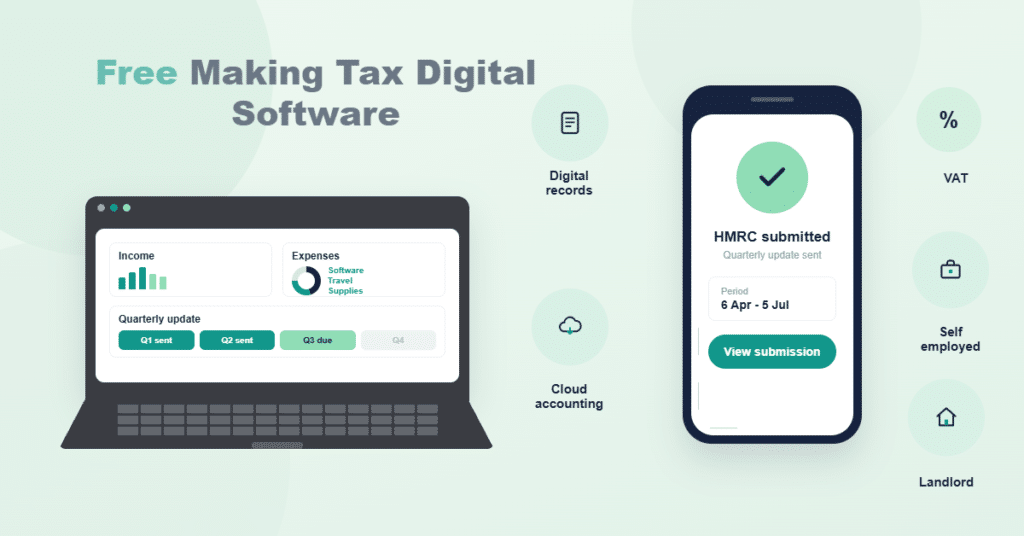
Making Tax Digital-compatible software connects directly to HMRC’s systems, so you can keep digital records and submit returns digitally. For MTD for Income Tax, the software must also allow you to submit quarterly returns to HMRC and file the Final Declaration, which combines all income sources and pension contributions, replacing the traditional Self Assessment tax return.
Disclosure: This content may contain affiliate links, which means if you click on them, I may get a commission (without any extra cost to you).
Digital record keeping is at the heart of MTD. You must store your income and expense records digitally, not just at submission time, but throughout the tax year. A good accounting app handles this automatically, meaning your digital records are always up to date and ready to submit.
💡 Tip: You do not have to use an expensive package to comply with MTD. Free or low-cost options work well for many sole traders, small landlords, and VAT-registered small businesses.
When Does MTD Apply to You?
MTD for VAT
If your business is VAT-registered, MTD for VAT now applies to you, whether you are a sole trader, a partnership, a limited company, or a landlord. Even if you registered for VAT voluntarily below the £90,000 registration threshold, you must still keep digital records and submit your VAT returns through MTD-compatible software.

MTD for Income Tax (MTD ITSA)
Making Tax Digital ITSA replaces Income Tax Self Assessment for those in scope and applies only to sole traders and landlords, not to partnerships. Qualifying income includes gross property income from UK property and overseas property, as well as income from self-employment.
The threshold is assessed using the gross income figure from the Self Assessment return due on 31 January before the start of the relevant tax year. Under MTD ITSA, you must keep digital records of all UK property income, expenses, and self-employment transactions throughout the year, not just at the time of filing. MTD ITSA rolls out in phases:
- From 6 April 2026: qualifying gross income over £50,000 (based on your 2024/25 Self Assessment return).
- From 6 April 2027: qualifying income over £30,000.
- From 6 April 2028: qualifying income over £20,000.
Free MTD-Compliant Software Options
Below are four options that offer free or no-cost accounts with MTD compatibility. All four support Making Tax Digital VAT submissions, making them relevant to any VAT-registered business. They also support MTD ITSA for sole traders and landlords, which is noted in each section. Each free software has its own strengths and limitations, so read the details before deciding.
1. Sage Accounting — Free software Plan for Sole Traders
Sage UK offers a permanently free accounting account designed specifically for sole traders. It is one of the few genuinely free options from a major cloud accounting provider, and it is HMRC-recognised software. The free account is not suitable for MTD VAT submissions; a paid version is required.


What the free account includes:
- Send and track 5 invoices per month
- Record income and expenses
- Digital record keeping for MTD compliance
- Bank reconciliation (connect your bank account)
- Basic profit and loss reporting
- Mobile app access
What it does not include:
- VAT – Sage Start plan required
- Payroll – you need a paid account or separate payroll software
- Multi-currency transactions
- Multiple users (the free account is single-user)
- Stock management
- Advanced reporting
Who it suits:
Sage’s free account works well for straightforward sole traders who invoice clients and track expenses.
💡Tip: Sage’s free sole trader account is a strong starting point if you are new to MTD and want an established, HMRC-recognised software platform without paying a monthly fee. Sage also offers discounted paid subscriptions
2. FreeAgent — Free software with Certain Bank Accounts
FreeAgent is a well-regarded accounting platform that is free if you bank with NatWest, Royal Bank of Scotland, Ulster or Mettle (NatWest’s business bank account). It is also available as a standalone paid subscription if you do not use those banks. Importantly, FreeAgent covers sole traders, freelancers, and limited companies, making it one of the few free options that works for VAT businesses.
What FreeAgent includes (with an eligible bank account):
- Full invoicing and expense tracking
- Digital records of income and expenses for MTD compliance
- Making Tax Digital VAT submissions to HMRC
- Ability to submit quarterly updates for MTD ITSA (check provider for current status)
- Self Assessment tax return preparation (for sole traders)
- Payroll (basic payroll included)
- Time tracking
- Project management tools
- Bank feeds and reconciliation
- Corporation Tax tools (for limited companies)
What it does not include:
- Multi-currency support on the standard plan
- Stock management
- Advanced custom reporting
Who it suits:
FreeAgent suits freelancers, sole traders, and limited companies — including VAT businesses — who already bank (or are willing to bank) with NatWest, RBS, Ulster, or Mettle. It is the most feature-complete free option on this page and handles MTD VAT, Self Assessment, and basic payroll in a single platform.
| ⚠️ Warning: The free access to FreeAgent depends on maintaining an active eligible bank account. If you close the account or switch banks, you will lose free access and will need to start paying a monthly subscription fee. |

3. Zoho Books — Free Plan for Very Small Businesses
Zoho Books offers a free version for businesses with fewer than 1000 invoices or expenses. It is MTD-compatible for VAT, which means it can suit very small VAT-registered businesses, not just sole traders, provided they stay within the turnover cap. For businesses that are voluntarily registered for VAT and have low turnover, Zoho Books is worth considering.
What the free version includes:
- Up to 1,000 invoices per year
- Expense recording and digital records of income
- Bank reconciliation (one bank account)
- Making Tax Digital VAT submissions
- Basic reporting
- Client portal
- One user only
What it does not include:
- Payroll
- Multiple users
- Advanced inventory management
- Automated bank feeds (available on paid plans)
- More than one bank account on the free tier
Who it suits:
Zoho Books’ free version suits sole traders, micro businesses, and VAT with simple invoicing needs. There is no turnover limit, but the free plan is capped at 1,000 invoices and 1,000 expenses a year, with access for one user plus your accountant. It includes both Making Tax Digital VAT filing and MTD Income Tax submissions, covering quarterly updates and your tax return without requiring an upgrade.
4. Clear Books — Free Sole Trader or Landlord Account
Clear Books offers a free account for sole traders and landlords. It is HMRC-recognised software and supports Making Tax Digital VAT submissions, making it relevant to VAT-registered sole traders and landlords.
What the free account includes:
- Income and expense recording with digital records for Making Tax Digital
- Basic invoicing
- MTD VAT submissions
- Simple profit and loss view
- Single user
What it does not include:
- Payroll
- Bank feeds or automated reconciliation (manual entry on the free account
- Multi-user access
- Advanced reporting
- Project tracking
Who it suits:
Clear Books suits sole traders and landlords with very simple finances who mainly need a place to keep digital records of income and expenses and to submit VAT returns. It covers UK property income and self-employment income for landlords.
Comparison: Free MTD-compliant Software at a Glance
| Feature | Sage Free | FreeAgent | Zoho Books Free | Clear Books Free |
| Cost | Free | Free (with eligible bank) | Free (1000 invoices or expenses) | Free |
| MTD VAT | ✅ | ✅ | ✅ | ✅ |
| Suits small VAT businesses | ✅ Sole traders & very small businesses | ✅ Sole traders, freelancers & limited companies | ✅Sole traders, small businesses and VAT registered | ✅ Very simple finances only |
| MTD ITSA ready | Check provider | Check provider | Check provider | Check provider |
| Invoicing | ✅ | ✅ | ✅ (up to 1,000/yr) | ✅ Basic |
| Bank feeds | ✅ | ✅ | Limited | ❌ Manual only |
| Payroll | ❌ Paid plan only | ✅ Basic | ❌ | ❌ |
| Multi-user | ❌ | Limited | ❌ | ❌ |
| Best for | Sole traders & small VAT businesses | Freelancers, sole traders & small limited companies with an eligible bank | VAT registered | Smallest VAT businesses with simple finances |
When a Free Account Is Not Enough
Free software covers the basics well, but there are situations where you will quickly hit the limits. This applies whether you are a sole trader, a landlord, or a VAT-registered business. You should consider a paid subscription if any of the following apply.
1. You employ staff
Free accounts, except FreeAgent, do not include payroll. If you pay even one employee, you need payroll software that handles PAYE, National Insurance, and RTI submissions to HMRC.
2. Your turnover is growing
If your business is growing, you may outgrow the free version within a tax year and switching software mid-year creates extra work.
3. You have complex VAT needs
Free accounts typically handle standard VAT returns. If you operate under the flat-rate scheme, the Cash Accounting Scheme, or have a partial exemption, you need software that supports those arrangements.
4. You need better reporting
Free accounts generally offer a basic profit and loss view and a handful of standard reports, not custom reports, cash flow forecasting, or reporting broken down by project, class, or location.
5. You need multiple users
If you want your bookkeeper, accountant, or a business partner to access your accounts, free accounts will sometimes not work. Paid subscriptions from Xero, QuickBooks, and Sage all support multiple users and different permission levels.
6. You run a limited company
Free accounts are generally designed for sole traders. Limited companies have additional reporting requirements, including statutory accounts, Corporation Tax, and Companies House filing.
7. You deal in foreign currencies
If you invoice clients abroad, pay international suppliers, or receive property income from foreign property, you need software that handles multi-currency transactions.
8. You are a landlord with a property portfolio
Landlords with multiple properties, or a mix of UK and foreign property income, may find the free accounts on this page too basic. Dedicated property management software, such as Landlord Vision, offers features focused on rental income, tenancy management, and property expenses.
9. You want full Making Tax Digital ITSA readiness
MTD for Income Tax Self Assessment requires your software to handle digital record keeping, send quarterly updates to HMRC, and file the Final Declaration. As MTD ITSA rolls out from April 2026, not all free accounts will be confirmed as fully compatible for income tax submissions.
| ⚠️ Warning: Excel spreadsheets alone are not sufficient for Making Tax Digital submissions. If you use Excel for your records and fall within the MTD for Income Tax thresholds, you must digitally link your spreadsheet to MTD-compatible bridging software for your quarterly submissions. |
Accounting Software Best Deals
If you have outgrown the free options or want the full feature set from day one, the three most popular paid cloud-based accounting software platforms for UK businesses are Xero, QuickBooks, and Sage. All three are HMRC-recognised software and Making Tax Digital compatible for VAT.
- Xero: 80% discount for 6 months. Full MTD-compatible accounting with automatic bank feeds, invoicing, VAT returns, payroll (add-on), and multi-user access. Strong for growing businesses and those working with an accountant.
- QuickBooks: 90% off for 7 months. MTD-compatible accounting with Self Assessment tools built in, making it popular with sole traders and freelancers. Includes payroll on higher-tier subscriptions.
- Sage UK Accounting (paid subscriptions): 90% discount for 6 months. Sage also offers a free sole trader account (see above). Paid subscriptions add payroll, multi-currency, and more advanced reporting; HMRC-recognised software with a strong track record with UK businesses.
- Landlord Vision: dedicated property management software for landlords with multiple properties. Covers rental income, tenancy management, property expenses, and financial reporting. Useful if your UK property or foreign property portfolio has grown beyond what a standard accounting app handles.

| 💡 Tip: Using Making Tax Digital compatible accounting software such as Xero, QuickBooks, or Sage now — even if you are not yet within the mandatory MTD for Income Tax thresholds — means you will be ready when your start date arrives. |
FAQ
Summary
Making Tax Digital for VAT has applied to all registered businesses since April 2022, and MTD for Income Tax rolls out in phases from April 2026 for sole traders and landlords, starting at £50,000 of qualifying income and dropping to £20,000 by 2028. Digital records and HMRC-recognised software are required for both.
The four free options covered here are MTD-compliant and work well for sole traders, landlords, and small VAT-registered businesses with simple accounting. Still, each has limits: invoice or expense caps, single-user access, basic reporting, or bank account restrictions. Once your business grows past those limits, Xero, QuickBooks, or Sage are the natural next step. Excel alone never meets Making Tax Digital requirements without bridging software.
Related Pages on Business Accounting Basics
- Making Tax Digital for VAT
- Making Tax Digital for Income Tax
- Self-Employed Bookkeeping
- Accounting Software Reviews
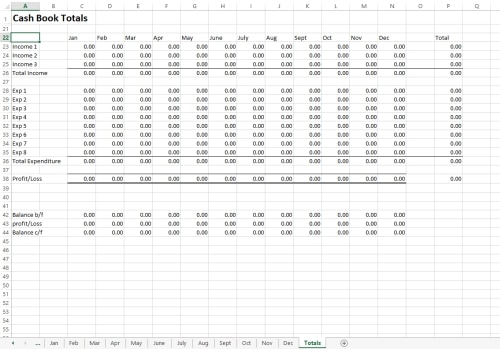
- Free Excel Bookkeeping Templates
Last updated: July 2026