


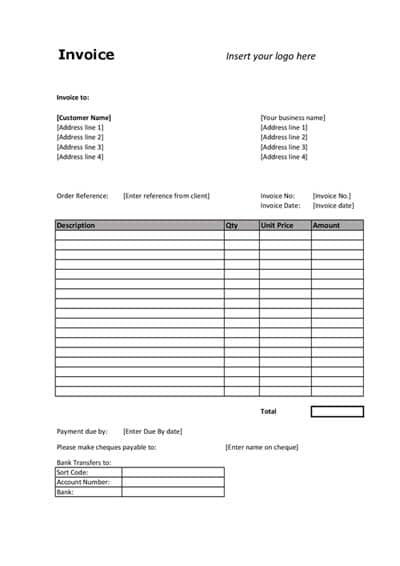
If you need a straightforward way to invoice your customers, this page gives you a free UK sales invoice template you can download and use straight away — no sign-up required. Templates are available in Excel, Google Sheets, and PDF format, in both VAT and non-VAT versions, so you can choose whichever suits your business.
The templates are designed for sole traders, freelancers, and small business owners who want to produce professional, accurate invoices without the cost of accounting software. Add your business name, logo, and payment details once, save it as your master template, and reuse it for every invoice you raise.
What is a Sales Invoice?
A sales invoice is a document that a business sends to a customer, acting as an official record of a sale. It functions as a detailed bill. Here’s a breakdown of its key features:
Disclosure: This content may contain affiliate links, which means if you click on them, I may get a commission (without any extra cost to you).
- Request for Payment: This request asks the customer to pay for the goods or services provided.
- Transaction Details: This outlines what was sold, the sale date, and the total amount owed.
- Payment Terms: It specifies how and when the payment is due (e.g., net 30 days).
- Legal Record: It serves as a legal record of the transaction for both the buyer and seller.
- Accounting Purposes: It’s an essential document for a business’s accounting processes, helping track income and sales tax.
In essence, it’s a way to ensure everyone is on the same page about what was sold, its cost, and when the payment is due. Using a free invoice template will make the process easier.

Is Accounting Software a Better Option?
An Excel template works well for small businesses with a straightforward invoicing process. As your business grows, accounting software such as Sage UK, Xero or QuickBooks offers some practical advantages worth considering.
Invoices are created, sent, and tracked in one place. Calculations including VAT and discounts are handled automatically, reducing the risk of errors. Most packages support online payment links, allowing customers to pay directly from the invoice, which can speed up cash flow. Recurring invoices can be automated for clients you bill regularly, and you can see at a glance which invoices are outstanding or overdue without maintaining a separate tracker.
From a compliance perspective, all three packages are MTD-compatible for VAT and will handle your quarterly submissions and Final Declaration when Making Tax Digital for Income Tax applies to you.


UK TAX Compliance

| From £18 per month |
| FREE plan for sole traders |
| UK Accounting and Tax |
| 90% Discount – 6 Months |
Free plan available

From £12 per month |
| Free plan available |
| Works with other Zoho Apps |
| Self-Assessment filing |
Instructions for Free Excel Invoice Template UK
Download the template below and select either the VAT or non-VAT version. Open it in Excel or Google Sheets and follow these steps to set it up as a reusable template for your business.
Step 1 — Add your business details. Enter your company name, address, and payment details. For bank transfer payments, add your sort code, account number, and bank name. For cheque payments, enter your cheque payee name.
Step 2 — Add your logo (optional). The sheet is protected by default to prevent accidental changes to the formulas. To add a logo, go to File > Info > Protect Workbook and click Unprotect — the password is blank. Click on the logo area, select Insert, then choose your image file. If you do not have a logo, simply delete that section. Re-protect the sheet when you are done.
Step 3 — Add your VAT number (VAT-registered businesses). If you are VAT registered, enter your VAT registration number in the designated field. The template will automatically display the VAT rate and amount on every invoice.
Step 4 — Save as your master template. Once your details are entered, save the file with a clear name, such as “Sales Invoice Template 2026.” Each time you raise a new invoice, open this file and save a copy with the invoice number and customer name before entering the transaction details — this keeps your master template clean and ready to reuse.
⚠️ Limited companies — legal requirement: You must include your company registration number, the exact business name as shown on your certificate of incorporation, and your registered address on every invoice. There are two rows at the bottom of the template for this information. This is a legal requirement under the Companies Act.
💡 Tip: If you invoice the same customer regularly, save a version of the template with their details already filled in. Name it by customer so you can find it quickly and avoid re-entering their information each time.
How to Issue Sales Invoices
Complete the following information for each bill.
- Unique Invoice Number: Every invoice must have a unique number issued in sequence without gaps — HMRC expects an unbroken audit trail of all invoices raised. Avoid starting at 1; use 100, 1000, or a year-based format such as 2025-001 instead. If you need to cancel an invoice after sending it, issue a credit note rather than deleting it or reusing the invoice number.
- Invoice Details:
- Date: Include the date the invoice is created.
- Customer Reference: Add any reference provided by your customer, such as a purchase order number or contact name.
- Itemised List:
- Description: Clearly describe the service or item sold.
- Quantity: Enter the number of units sold.
- Unit Price: Indicate the price per unit.
- VAT (if applicable):
- VAT Percentage: For VAT-registered businesses, include the VAT rate for each item.
- Automatic Calculations: Our VAT template calculates VAT automatically.
- Payment Terms:
- Due Date: Specify the payment due date based on your agreed credit terms — typically 7, 14, or 30 days from the invoice date. If a customer pays late, you are legally entitled to charge statutory late payment interest under the Late Payment of Commercial Debts Act. The current rate is 8% above the Bank of England base rate for business-to-business transactions. Always check GOV.UK for the current rate.
- Saving and Sending:
- Unique Reference: Save the document with a clear, easy-to-find reference, typically the invoice number.
- Optional Client Reference: Consider including the client name followed by the invoice number (e.g., Acme Ltd – INV-2024-001) for better organisation.
- Delivery Options:
- Email or Post: Send the invoice electronically or by mail to your client.
- Paper Records: Print a copy for your files if you maintain paper records.
For more information on what to include in a sales invoice, refer to the HMRC guide.
Sample of Invoice Templates UK
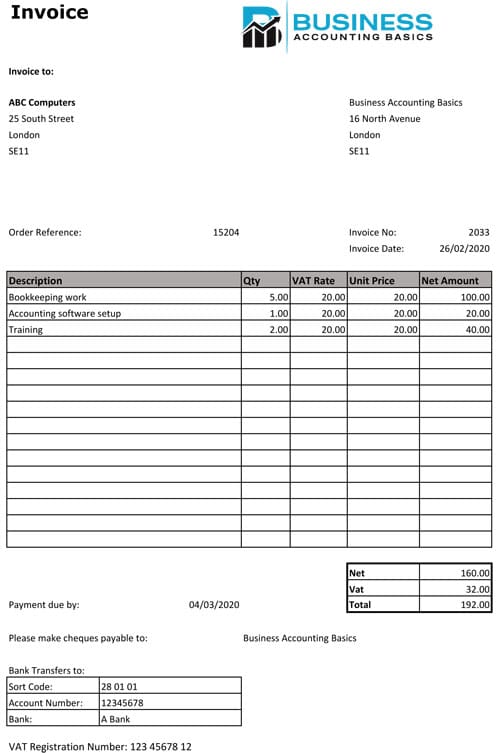
Below is an example of a VAT sales invoice issued to a customer for accounting services. The sales tax is calculated automatically in the template.
Invoicing and Making Tax Digital
If you are VAT registered
Every sales invoice you issue to a VAT-registered customer must be a full VAT invoice, showing your VAT registration number, the VAT rate, the VAT amount, and the total including VAT. The VAT version of the template includes all of these fields. Under Making Tax Digital for VAT, which has applied to all VAT-registered businesses since April 2022, you must keep digital VAT records and submit your VAT returns using MTD-compatible software.
If you are self-employed or a sole trader
Every sales invoice you issue is a record of your business income and must be included in your Self Assessment tax return. Keep copies of all invoices — HMRC requires you to retain business records for at least five years after the 31 January filing deadline for the relevant tax year.
If your qualifying gross income is over £50,000, Making Tax Digital for Income Tax applies to you from April 2026. From that date, you will need to keep digital records and submit quarterly updates to HMRC using MTD-compatible software, with a Final Declaration replacing your annual Self Assessment return. The threshold will reduce to £30,000 from April 2027 and to £20,000 from April 2028.
There are two ways to meet this requirement alongside a template-based invoicing system. The first is to use a full accounting package such as Sage UK, Xero or QuickBooks, which handles both your records and VAT return submission in one place. The second is to use MTD bridging software, which links your existing Excel records digitally to HMRC for submission without requiring you to change your bookkeeping system. Bridging software is a practical option if you are comfortable with spreadsheets and not ready to move to a full software package.
Accounting Software Best Deals
XERO – 80% Discount for 6 Months – Cloud accounting, unlimited users, bank feeds, MTD compatible

QuickBooks – 90% off for 7 Months – Sole traders, easy to use, MTD-compatible

Tide – Free with Tide Bank Account – All your banking and accounts in one place, MTD compatible
Keeping Track of Your Sales Invoices
One of the most effective ways to manage and track invoices is by using our sales invoice list template. This template allows you to record all your invoices in a single, organised document, making it easy to track payments and due dates.

Excel Sales Invoice Template UK – Licence Agreement
By downloading our free invoice templates, you agree to our licence agreement, allowing you to use the templates for your own personal or business use only. You may not share, distribute, or resell the templates to anyone else in any way.
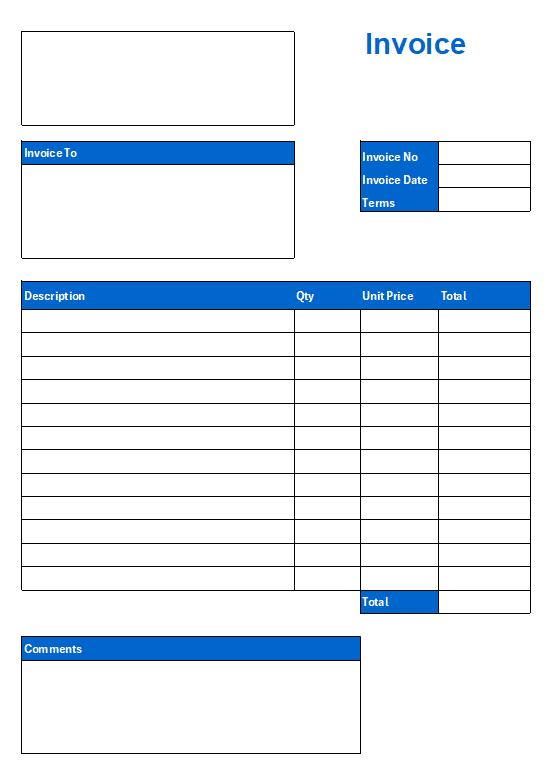
You agree to the licence agreement by downloading the free sales invoice template by clicking on the link below. If you’re unsure which template to use, refer to the images below.
Invoice Non-VAT

Invoice VAT
Printable Invoice Template PDF


Sales Invoice Template FAQ
Sales Invoice Template Conclusion
A well-produced invoice does more than request payment; it reflects the professionalism of your business and gives both you and your customer a clear record of the transaction. The free templates on this page give you everything you need to invoice accurately and consistently, whether you are VAT registered or not.
As your business grows and your invoicing volume increases, accounting software such as Xero, QuickBooks, or Sage will save time and reduce the risk of errors — handling calculations, VAT, and MTD submissions automatically. If you are not ready to make that move yet, the templates on this page are a solid starting point.

Excel Bookkeeping Templates
Check out our other Excel Bookkeeping templates, including a word receipt template, cash book, profit and loss, balance sheet and petty cash.
We also offer a proforma invoice template.
Last updated: April 2026
Disclaimer: This template is provided for general bookkeeping purposes and is not a substitute for professional tax advice. Check that it suits your circumstances and review current HMRC requirements before submitting information.
