


Prepayments in Accounting
Understand how prepayments work, where they appear in the accounts and how to calculate them with clear examples and our free calculator.
A prepayment in accounting occurs when a business pays for goods or services before using them. Common examples include insurance, rent, subscriptions, and service contracts paid in advance but covering several months.
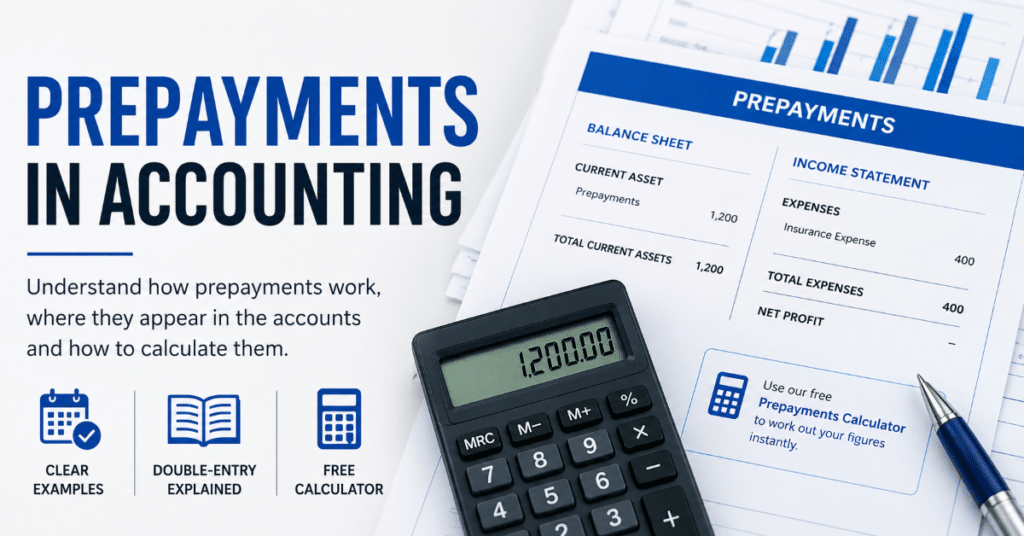
Under accrual accounting, only the amount relating to the current accounting period is recorded as an expense. The remaining amount is treated as a prepayment and shown as a current asset on the balance sheet until the expense is due.
This guide explains how prepayments work, the double-entry bookkeeping involved using accounting journals and where they appear in the accounts. It also includes worked examples and a free prepayments calculator to help you calculate your own figures.
Disclosure: This content may contain affiliate links, which means if you click on them, I may get a commission (without any extra cost to you).
What Are Prepayments in Accounting?
Prepayments are expenses a business has paid in advance that relate partly or entirely to a future accounting period. Rather than recording the full payment as an expense immediately, the amount relating to a future period is recorded as a current asset on the balance sheet.
For example, a business might pay £1,200 for 12 months of insurance. If four months relate to the current period, £400 is recorded as an insurance expense and the remaining £800 as a prepayment. The £800 is then charged to expenses as the insurance cover is used.
Common examples of prepayments include insurance, rent, software subscriptions, licences and service contracts paid in advance.
Why Are Prepayments Needed?
Prepayments ensure that expenses are recorded in the accounting period they relate to, rather than simply when they are paid. This follows the accrual basis of accounting and helps produce more accurate financial statements by ensuring the correct expenses are included in each period.
For example, if a business pays 12 months of insurance shortly before its year-end, recording the whole payment as an expense would reduce the current year’s profit even though most of the insurance relates to the following year.
By recording the unused amount as a prepayment, the expense is spread across the correct accounting periods. This improves the accuracy of both the profit and loss account and balance sheet.
Prepayments on the Balance Sheet
Prepaid expenses are shown as current assets on the balance sheet because they represent goods or services that the business has already paid for but has not yet used.
As the goods or services are used, the value of the prepayment reduces, and the amount is transferred to the relevant expense in the profit and loss account. Eventually, the full amount is recognised as an expense.
In the balance sheet example below, the business has £800 of prepayments included within current assets. This represents expenses already paid that relate to a future period.

Prepayments Double Entry
The double entry for a prepayment moves the part of an expense that relates to a future period from the profit and loss account to the balance sheet.
At the end of the accounting period, the adjustment is:
- Debit: Prepayments – Balance Sheet
- Credit: Expense – Profit and Loss
This removes the amount paid in advance from the current period’s expenses and records it as a current asset.
Recording the Prepayment as an Expense
As the goods or services are used, the relevant amount is transferred from prepayments back to the expense account. This might be done monthly, quarterly or at another appropriate interval.
The double entry is:
- Debit: Expense – Profit and Loss
- Credit: Prepayments – Balance Sheet
For example, if an £800 prepayment covers eight months, £100 could be transferred to the expense account each month. The prepayment balance reduces by £100 each month until the full £800 has been recognised as an expense.
The examples below show how these entries work in practice.
Prepayments Examples
The following two examples show how prepayments work in practice, including how to calculate the amount relating to the current accounting period and the amount carried forward as a prepayment.
Insurance Prepayment Example
A business pays 1,200.00 for 12 months of insurance in September. Its financial year runs from January to December.
Four months of the insurance relate to the current financial year, so 400.00 is recorded as an insurance expense. The remaining eight months, worth 800.00, are recorded as a prepayment because they relate to the following financial year.
The accounting entries are:
|
Account |
Debit |
Credit |
|
Insurance (P&L) |
1200.00 |
|
|
Bank (Balance Sheet) |
1200.00 |
The journal to transfer the 800.00 prepayment to the balance sheet is:
|
Account |
Debit |
Credit |
|
Prepayments (Balance Sheet) |
800.00 |
|
|
Insurance (P&L) |
800.00 |
This reduces the insurance expense in the profit and loss account to 400.00, representing the four months that relate to the current period.
Prepayment Schedule
A prepayment schedule helps keep track of an amount paid in advance and shows how it is transferred to expenses over time. It can be particularly useful when a prepayment covers several months, and the expense is recognised monthly.
Using the insurance example above, 800.00 is carried forward as a prepayment. The schedule below shows how 100.00 is transferred to the insurance expense each month until the prepayment balance reaches zero.
|
Month |
Opening Prepayment |
Expense |
Closing Prepayment |
|---|---|---|---|
|
January |
800.00 |
100.00 |
700.00 |
|
February |
700.00 |
100.00 |
600.00 |
|
March |
600.00 |
100.00 |
500.00 |
|
April |
500.00 |
100.00 |
400.00 |
|
May |
400.00 |
100.00 |
300.00 |
|
June |
300.00 |
100.00 |
200.00 |
|
July |
200.00 |
100.00 |
100.00 |
|
August |
100.00 |
100.00 |
0.00 |
Prepaid Rent Example
A business pays 6,000.00 for 12 months of office rent in advance, at 500.00 per month. The rental period runs from March to February, while the business’s financial year runs from April to March.
Eleven months of the rent, totalling 5,500.00, relate to the current financial year. The remaining month, worth 500.00, is recorded as a prepayment because it relates to the following financial year.
The accounting entries are:
|
Account |
Debit |
Credit |
|
Rent (P&L) |
6000.00 |
|
|
Bank (Balance Sheet) |
6000.00 |
The journal to transfer the 500.00 prepayment to the balance sheet is:
|
Account |
Debit |
Credit |
|
Prepayment (Balance Sheet) |
500.00 |
|
|
Rent (P&L) |
500.00 |
This reduces the insurance expense in the profit and loss account to 5,500.00, representing the 11 months that relate to the current financial year.
Free Online Prepayments Calculator
Using the insurance example above, the calculator splits the 1,200.00 payment between the amount charged as an expense and the amount carried forward as a prepayment.

Use the calculator below to work out how much of a payment should be recorded as an expense in the current accounting period and how much should be carried forward as a prepayment.
Enter the total amount paid, the number of months the payment covers, and the number of those months that fall within the current accounting period. The calculator will show the monthly cost, the expense for the current period and the remaining amount to record as a prepayment.
You can enter amounts in any currency.
How to Record Prepayments in Accounting Software
Accounting software makes it easier to record and manage prepayments. You can use an accounting journal to transfer the amount relating to a future accounting period from the expense account to prepayments on the balance sheet.
The Xero example below uses the insurance example above. 800.00 is debited to Prepayments and credited to Insurance, leaving 400.00 as the insurance expense for the current year.
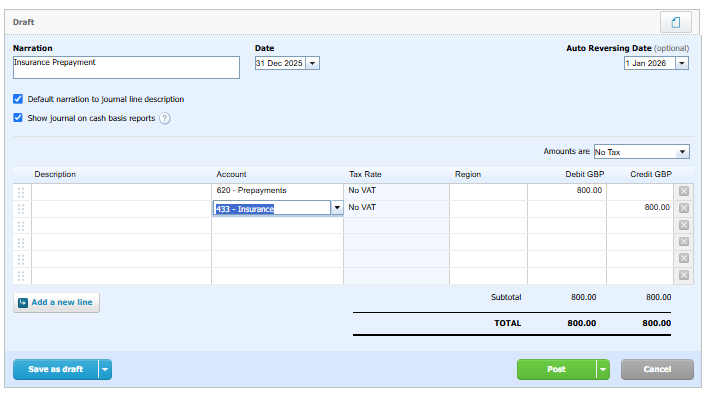
Xero also allows you to add an auto-reversing date to a manual journal. This can be useful when the whole prepayment needs to be reversed on a particular date. If the expense is being recognised monthly, separate or recurring journals may be more appropriate.

Prepayments FAQs
Prepayments – Summary
Prepayments ensure that expenses are recorded in the accounting period they relate to, giving a more accurate picture of the business’s profit and financial position. The amount paid in advance is recorded as a current asset on the balance sheet and transferred to the relevant expense account as it becomes due.
Using a prepayments schedule or accounting software can help keep these adjustments accurate, and our free prepayments calculator can help you work out the amount to carry forward.
