

Debt Collection Letter Template
Request payment for overdue invoices with our free Word template, example wording and guidance on when to take further action.
Unpaid invoices take time to chase and can put pressure on your cash flow. An effective debt collection letter sets out what the customer owes, how to pay and when you expect a response.
This guide includes two free Word downloads: payment reminder letters for routine chasing and separate Letter of Claim templates for when you are considering court action. Choose the letter that suits the stage of your debt recovery process and adapt it to your customer.
You’ll also find example wording, instructions and guidance on the different requirements for limited companies, sole traders and individuals. The formal Letter of Claim guidance applies to England and Wales.
Disclosure: This content may contain affiliate links, which means if you click on them, I may get a commission (without any extra cost to you).
Debt Collection Letters at a Glance
- Two free Word downloads: Payment reminders and formal Letter of Claim templates.
- Choose the right stage: Start with a reminder and consider a Letter of Claim before court action.
- Check the details: Confirm the invoice balance, due date and customer’s legal name.
- Make payment easy: Include payment instructions and contact details for queries.
- Follow the correct procedure: Formal claims against individuals and sole traders need additional forms and response time.
- Keep records: Save copies of letters, supporting documents and customer replies.
What Is a Debt Collection Letter?
A debt collection letter is a written request for payment of an overdue debt. It tells the customer which invoices remain unpaid, the outstanding balance, how to pay and when to respond.
A business can send the letter itself or ask a debt collection agency or solicitor to act on its behalf. The tone may range from a friendly first reminder to a firmer final payment request.
A routine collection letter is different from a formal Letter of Claim, which sets out an intended court claim and must follow the relevant pre-action requirements.
Which Debt Collection Letter Should You Use?
Choose a letter that reflects your previous contact with the customer and the next step you are prepared to take. Before sending it, check that the balance is correct and any invoice queries have been addressed.
First Payment Reminder
Use this when an invoice has become overdue and you have not yet sent a written reminder. Keep it polite and direct, as the customer may have overlooked the invoice.
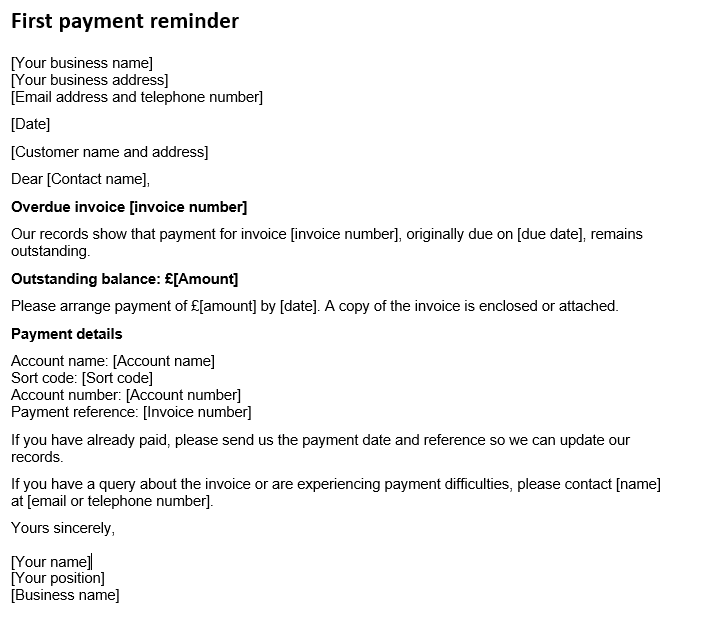
Include the invoice number, original due date, outstanding amount and payment instructions. Ask them to pay by a specific date or contact you with any queries.
Final Payment Reminder
Use a firmer letter when earlier reminders have not produced payment or a satisfactory response. Refer to your previous contact, set a clear deadline and invite the customer to raise a dispute or discuss a payment arrangement.
Explain that you may consider debt recovery or court action. Mention interest and recovery charges only where applicable, without suggesting that every cost is automatically payable.
Letter of Claim Before Court Action
Use a formal Letter of Claim when you intend to pursue an unpaid debt through the courts. It explains the basis of your claim, the amount owed and how the customer can respond.
The requirements depend on who owes the money. In England and Wales, claims against individuals and sole traders generally require additional forms and at least 30 days to respond. Different requirements apply to limited companies, as explained below.
Our payment reminder download contains the first and final reminders. The separate Letter of Claim download includes versions for individuals and sole traders, and limited companies.
How to Write a Debt Collection Letter
Keep your letter clear, factual and polite. The customer should be able to identify the debt, check the amount and understand what you are asking them to do.
Include:
- Your business details: Legal or trading name, address and contact details.
- Customer details: The correct legal name and address of the person or company that owes the money.
- Date and reference: The letter date, invoice number and account reference, if applicable.
- Debt details: What the invoice covers, its original due date and the outstanding balance after payments and credit notes.
- Interest and charges: Show these separately, explain their basis and include them only where applicable.
- Payment instructions: How to pay and which payment reference to use.
- A response deadline: Give a specific date appropriate to the letter and circumstances.
- A way to resolve queries: Explain who to contact about a dispute or payment arrangement.
- Possible next steps: State only actions you are prepared and entitled to take.
Attach copies of the relevant invoices and an up-to-date statement of account. Avoid aggressive language, misleading threats or claims that court action will automatically result in additional costs.
Check the balance again before sending, then save a dated copy and record how it was sent. If you are preparing a formal Letter of Claim, follow the additional requirements explained below.
Debt Collection Letter Examples
These examples show how to move from a polite reminder to a firmer payment request. You do not need to copy the wording from this page. Download our free payment reminder letters in Word below for the full editable versions, including spaces for your business details, invoice information and payment instructions.
First Payment Reminder Example
Subject: Payment reminder for invoice INV-1042
Dear Alex,
Our records show that invoice INV-1042 for £750, due on 1 June, remains unpaid.
Please arrange payment by 15 June, using invoice number INV-1042 as your payment reference. A copy of the invoice is attached.
Payment details: [Account name, sort code and account number]
If you have already paid, please send the payment date and reference so we can update our records. If you have any queries or need to discuss payment, contact us at [email or telephone number].
Yours sincerely,
[Your name]
[Business name]
Final Payment Reminder Example
Subject: Final payment reminder for invoice INV-1042
Dear Alex,
Despite our reminder dated 8 June, invoice INV-1042 for £750, originally due on 1 June, remains unpaid.
Please pay the outstanding balance by 29 June, or contact us by that date to explain any dispute or discuss a payment arrangement.
Payment details: [Account name, sort code and account number]
If we do not receive payment or a response, we may refer the account for debt recovery or consider court proceedings. Where applicable, we may also seek late-payment interest, recovery charges and recoverable court fees.
Yours sincerely,
[Your name]
[Business name]
These are payment reminders, rather than formal Letters of Claim. Use the separate Letter of Claim template and follow the relevant procedure if you intend to start court action.

Sending a Formal Letter of Claim
A formal Letter of Claim explains why you are owed money and gives the customer an opportunity to respond before court proceedings. Check the customer’s legal identity first, as the procedure differs for individuals, sole traders and limited companies.
The guidance below applies to England and Wales.
Individuals and Sole Traders
The Pre-Action Protocol for Debt Claims generally applies when a business claims payment from an individual, including a sole trader.
Your Letter of Claim should explain:
- How the debt arose and the agreement it relates to.
- The amount owed and whether interest or charges continue to accrue.
- How to pay or discuss a payment arrangement.
- Include the required forms and allow at least 30 days from the date of the letter for a response.
- Where to return the completed Reply Form.
Send the letter by post on the date shown or, if that is not reasonably possible, the following day. You can also email a copy. Alternative delivery arrangements apply where the customer has explicitly requested correspondence by another method.
Do not assume you can start proceedings immediately after 30 days. A response, document request or request for debt advice may mean you need to allow further time. If the customer responds but no agreement is reached, normally give at least 14 days’ notice of your intention to issue proceedings, after meeting the other requirements.
Limited Companies and LLPs
The Pre-Action Protocol for Debt Claims generally does not apply to debts owed by limited companies or limited liability partnerships (LLPs). Where no specific protocol applies, follow the Practice Direction on Pre-Action Conduct and Protocols.
Set out the basis of the claim, how the amount has been calculated and the relevant supporting evidence. Allow a reasonable response period, normally 14 days for a straightforward claim, with longer periods for complex cases.
Consider any response and whether discussion, a payment arrangement or mediation could resolve the matter before court action.
Required Forms and Supporting Documents
For claims against individuals and sole traders, include:
- The official Information Sheet.
- The official Reply Form.
- A Financial Statement form.
- An up-to-date statement of account showing the balance and any interest or charges.
- Relevant invoices, agreement details and supporting documents.
Find the forms in the annexes at the end of the official Pre-Action Protocol for Debt Claims PDF. Annex 1 contains the Information Sheet and Reply Form; Annex 2 contains the Financial Statement. Send the complete forms with your letter, rather than just providing a link.
For limited-company debts, provide the key documents supporting your claim, such as the agreement, invoices, statement and relevant correspondence.
Our free Letter of Claim Word download includes a version for each customer type, with instructions to help you complete it.

Adding Late-Payment Interest and Recovery Charges
For qualifying business debts, you can usually claim statutory interest at 8% above the applicable Bank of England reference rate. Check your contract first, as an agreed interest provision may apply instead.
You may also claim a fixed recovery charge for each qualifying late payment:
| Outstanding debt | Fixed recovery charge |
|---|---|
| Under £1,000 | £40 |
| £1,000 to £9,999.99 | £70 |
| £10,000 or more | £100 |
These commercial late-payment rules apply to business customers, including sole traders buying for their business. They do not apply to consumers.
Example of Interest and Recovery Charges
A business customer owes £2,000, which is 30 days overdue. Using an illustrative Bank of England reference rate of 4%, the annual statutory interest rate is 12%.
| Item | Amount |
|---|---|
| Outstanding invoice | £2,000.00 |
| Interest: £2,000 × 12% ÷ 365 × 30 days | £19.73 |
| Fixed recovery charge | £70.00 |
| Total claimed | £2,089.73 |
The recovery charge applies once to this qualifying late payment, rather than each time you send a reminder.
For statutory interest, the reference rate is the Bank of England base rate on 31 December for January to June, and 30 June for July to December. The 4% rate above is an example, not a statement of the current rate.
Show the invoice balance, interest and recovery charge separately in your debt collection letter. If interest continues to accrue, state the daily amount and provide the calculation. You can check your figures using the Small Business Commissioner’s interest calculator.
How Accounting Software Helps with Payment Reminders
Accounting software reduces manual chasing by helping you send invoices, monitor overdue balances and follow up consistently.
With Xero, you can set up automatic invoice reminders and customise the wording. Include the invoice number, amount due and payment instructions so customers can act on the reminder.
QuickBooks and Sage can help you prepare customer statements showing invoices, credit notes and payments. A statement is particularly useful when several invoices remain unpaid and the customer needs a breakdown of their balance.
Check which features your chosen product and plan includes. Pause reminders for disputed invoices or agreed payment arrangements, and contact customers personally when automatic emails do not produce a response.
Keep Customer Records Up to Date
Before sending a debt collection letter, check the customer’s outstanding invoices, payments and credit notes. An accurate balance helps you avoid chasing money already paid or requesting the wrong amount.
Xero brings customer invoices, balances and account history together. You can also add notes about calls, payment promises and disputes, helping anyone following up understand what has already been agreed.
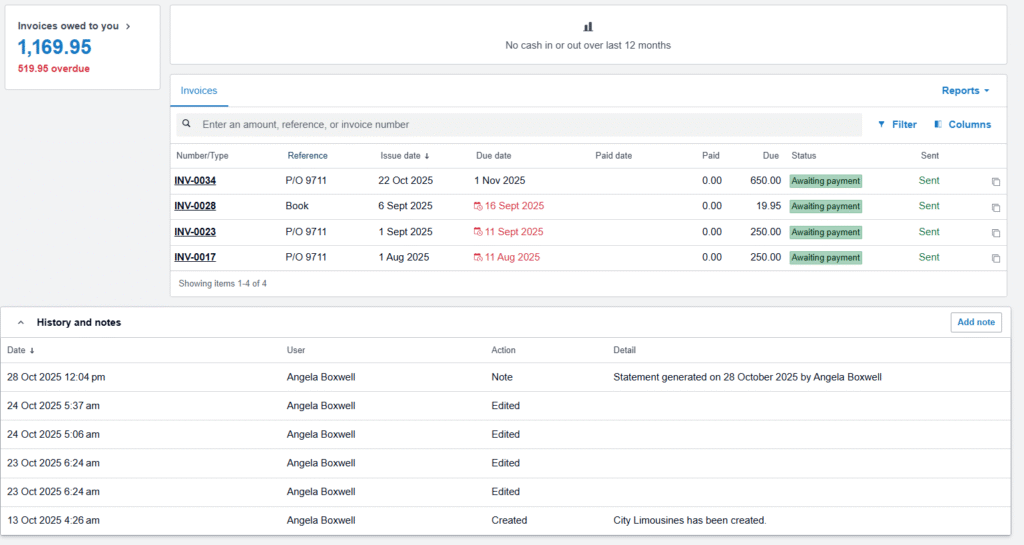
The example below shows a customer balance of £1,169.95, including £519.95 overdue, alongside individual invoices and the history and notes section. Keep relevant emails and supporting documents with your records, especially if you are considering further debt recovery action.
Download Your Free Debt Collection Letter Templates
Choose from two free Word downloads, depending on whether you are chasing an overdue invoice or preparing for possible court action. Both include editable letters and instructions.
By downloading these templates, you agree to our licence agreement.
Payment Reminder Letters in Word
This download includes:
- First payment reminder: A polite request for an overdue payment.
- Final payment reminder: A firmer follow-up explaining possible further action.
Use these for routine payment chasing. They do not replace a formal Letter of Claim.

Letter of Claim Templates in Word
This download includes separate versions for:
- Individuals and sole traders.
- Limited companies.
The templates cover ordinary unpaid invoice claims in England and Wales. Read the instructions and attach the supporting documents. For individuals and sole traders, you must also obtain and include the official forms identified in the instructions.
How to Complete and Send Your Letter
- Open the download in Word or a compatible word processor.
- Choose the appropriate letter and replace all bracketed placeholders.
- Check the customer’s legal name, invoice balance, dates and payment details.
- Remove unused optional wording and attach the documents referred to.
- Save the completed letter separately and keep a record of how and when you sent it.
For a Letter of Claim, follow the response periods and delivery requirements explained above and in the download.
What to Do if the Customer Does Not Pay
If the deadline passes without payment, check for recent receipts and customer replies before taking further action. Confirm that the balance is correct and consider whether a payment arrangement could resolve the matter.
Your next step depends on the letter you sent:
- After a first reminder: Contact the customer and send a final payment reminder if appropriate.
- After a final reminder: Consider a formal Letter of Claim, following the procedure that applies to the customer.
- After a Letter of Claim: Review any response and complete the required pre-action steps before deciding whether to issue a court claim.
A debt collection agency or solicitor may help with further recovery. Check their fees and what their service includes. Compare the likely costs with the amount owed and the customer’s ability to pay.
Legal action does not guarantee recovery. If the debt is unlikely to be collected, consider whether it should be treated as a bad debt.
For more information, see GOV.UK’s guide to making a court claim for money. Our credit control guide explains how to manage overdue accounts and reduce future payment problems.
Debt Collection Letter FAQs
Debt Collection Letter Summary
A clear debt collection letter helps customers understand what they owe, how to pay and when to respond. Check the balance, keep the wording factual and give them a way to raise queries or discuss payment difficulties.
Use our free payment reminder letters for routine chasing and the separate Letter of Claim templates when you intend to pursue court action. Choose the correct version for your customer, include the supporting documents and keep copies of all correspondence.
