Small Business Taxation Accounting (UK) – A Simple Guide
Small business taxation accounting is about understanding what tax your business needs to pay and making sure you report it correctly to HMRC. For many small business owners, taxes feel confusing, stressful, and easy to get wrong.
The good news is that with good bookkeeping, clear records, and simple systems, tax accounting becomes much easier to manage. You do not need to be an accountant, but you do need to understand the basics.
This guide explains tax accounting in plain English, so you know what’s required, what to keep, and how to avoid common mistakes.
What Is Tax Accounting?
Small business tax accounting is the process of using your business records to work out how much tax you owe and to complete your tax returns correctly.
Disclosure: This content may contain affiliate links, which means if you click on them, I may get a commission (without any extra cost to you).
Bookkeeping and tax accounting work together. Bookkeeping records what happens in your business day to day. Tax accounting uses that information to calculate your taxable profit and prepare information for HMRC.
Proper tax accounting helps you stay in control and avoid last-minute panic.
Good tax accounting helps small business owners to:
- Stay compliant with HMRC
- Avoid late filing penalties and interest
- Plan for future tax bills
- Improve cash flow
- Reduce stress at tax time
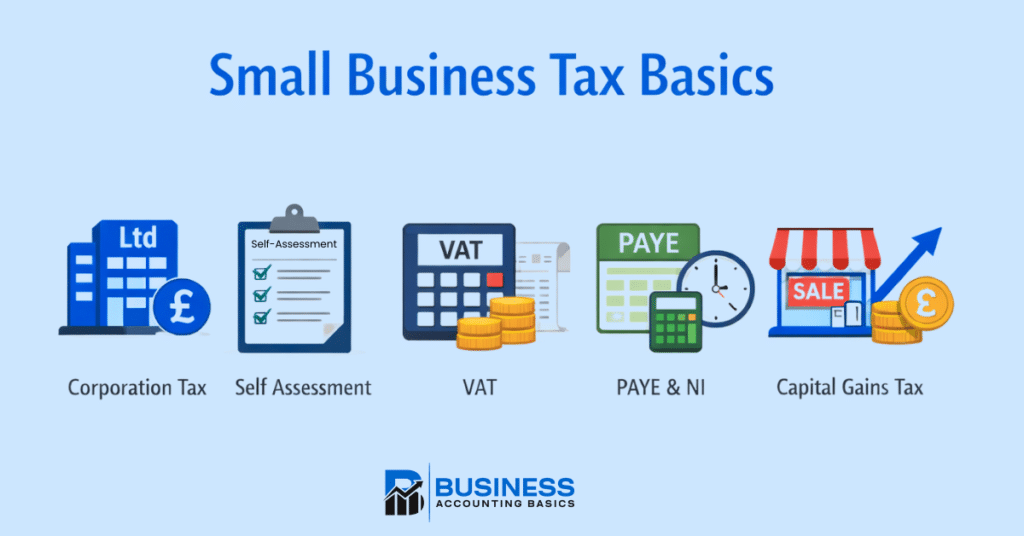
Small Business Taxes You Need to Know About (UK)
Most UK small businesses deal with more than one type of tax. Understanding which taxes apply to you helps you plan properly and avoid unexpected bills.
Different business structures and activities trigger different taxes, so it’s important to know what applies to your situation.
Income Tax and Corporation Tax
Your business structure determines which main business tax you pay. Understanding the difference between Income Tax and Corporation Tax helps you know what you owe and why.
Income Tax (for Sole Traders and Partnerships)
If you are self-employed as a sole trader or in a partnership, you pay Income Tax on your profits.
Your business profit is added to your other personal income, such as employment income or rental income. HMRC then works out how much Income Tax you owe based on your total income.
You report your profits through a Self Assessment tax return.
As a self-employed person, you may also have to pay National Insurance on your profits. This is separate from Income Tax and is part of your overall tax bill.
National Insurance for the self-employed helps cover things like:
- State Pension
- Certain benefits
Both Income Tax and National Insurance are based on your business profit, not on your turnover.
Corporation Tax (for Limited Companies)
If you run a limited company, the company pays Corporation Tax on its profits.
The company is treated as a separate legal entity. It means:
- The company’s profits belong to the company
- Corporation Tax is paid by the company, not by you personally
Directors and shareholders then pay personal tax on money they take out of the company, such as:
- Salary (through payroll)
- Dividends
It means limited company owners often pay both Corporation Tax on the company and Income Tax personally.
VAT (Value Added Tax)
VAT is a tax added to most goods and services sold in the UK. If your business is VAT-registered, you charge VAT to your customers and pay it to HMRC.
You can also usually reclaim VAT on business expenses that include VAT. The difference between the VAT you charge and the VAT you reclaim is what you pay to HMRC or get refunded.
VAT is not based on profit. It is based on sales and purchases, which means it can affect cash flow.
- You must register for VAT if your VAT taxable turnover goes over the VAT threshold of £90,000 on a 12-month rolling basis
- Some businesses register voluntarily
- VAT returns show VAT charged to customers and VAT reclaimed on expenses
VAT requires careful record-keeping and regular submissions.

PAYE and National Insurance
PAYE stands for Pay As You Earn. It is the system HMRC uses to collect Income Tax and National Insurance from wages and salaries.
If your business pays employees, or if you pay yourself as a director through payroll, you usually need to operate PAYE.
Under PAYE, your business must:
- Register as an employer with HMRC
- Run payroll
- Calculate tax and National Insurance
- Report payroll information to HMRC each time you pay staff
- Pay income tax and National Insurance to HMRC by the deadline
Payroll mistakes can quickly lead to HMRC penalties, so accuracy matters.
Capital Gains Tax
Capital Gains Tax is a tax on the profit (the “gain”) you make when you sell or dispose of certain assets.
For sole traders and partnerships, Capital Gains Tax may apply when you sell business assets, such as:
- Business property
- Land
- Equipment and machinery
- Shares
- Other valuable business assets
For limited companies, Capital Gains Tax does not apply. Instead, any gains made by the company are included in the company’s profits and are taxed under Corporation Tax.
Business Rates
Business rates are a tax charged on most non-domestic properties, such as shops, offices, warehouses, and other business premises.
If your business operates from a property that is not your home, you may need to pay business rates to your local council.
The amount of business rates you pay is based on:
- The property’s rateable value
- The business rates multiplier set by the government
- Any reliefs you qualify for
Many businesses qualify for Small Business Rates Relief, which can reduce your bill, depending on your property’s rateable value.
If you work from home, you usually do not pay business rates unless:
- Part of your home is used only for business
- You have made structural changes for business use
- Customers regularly visit your home for business purposes
Business rates are separate from Income Tax, Corporation Tax, and VAT. They are a property-based tax, not a profit-based tax.
Your local council is responsible for billing and collecting business rates, not HMRC.

How Your Business Structure Affects Tax
Your business structure changes how you report income and how you pay tax. Choosing the right structure and understanding the rules are essential parts of tax accounting.
Sole Traders
As a sole trader, you and your business are treated as the same for tax.
You must:
- Complete a Self Assessment tax return
- Pay Income Tax on profits
- Pay National Insurance contributions
Your business profit is added to your other income for tax purposes.
Check out our Self-employed tax calculator to estimate how much you could pay.
Limited Companies
A limited company is a separate legal entity.
The company must:
- File company accounts
- Pay Corporation Tax on profits
Directors often:
- Run payroll
- Take dividends and pay dividend tax
- Pay personal Income Tax on income from the company
Partnerships
In a partnership:
- The partnership files a partnership tax return
- Each partner files their own tax return
- Each partner pays tax on their share of profits
Tax Deadlines
HMRC deadlines are strict. Missing them can lead to automatic penalties and interest, even if you owe very little tax.
Keeping your records up to date makes it much easier to meet deadlines without stress.
| Tax Type | Form Submission Deadline | Payment Due |
|---|---|---|
| Self Assessment | 31 January (online tax return) | 31 January (tax payment due) |
| Corporation Tax | 12 months after end of accounting period | 9 months and 1 day after end of accounting period |
| VAT | Usually 1 month and 7 days after VAT period end | Usually 1 month and 7 days after VAT period end |
| PAYE | On or before each payday (RTI submission) | Usually by 22nd of the following month (online) |
Good bookkeeping supports accurate and on-time submissions and payments.
What Records You Must Keep
HMRC requires businesses to keep clear and accurate records. These records support your tax returns and protect you if HMRC ever asks questions about your figures.
Good records also help you understand how your business is performing, so you can make better decisions and stay in control of your cash flow.
You should keep records of:
- Sales and income
- Business expenses
- Bank statements
- VAT records (if registered)
- Payroll records (if applicable)
Most businesses must keep records for at least 6 years.
Using good accounting software can make record-keeping much easier and more accurate. Software such as Sage UK, Xero or QuickBooks can help.
Accounting Software Best Deals
Sage UK – 90% Discount for 6 Months – FREE plan for Sole-Traders, AI tools for bookkeeping automation
XERO – 95% Discount for 6 Months – Cloud accounting, unlimited users, smart bank feeds

QuickBooks – 90% Discount for 7 Months – Invoicing, expense tracking, payroll, financial reports
Poor records are one of the main causes of tax errors and HMRC enquiries. Simple systems and regular updates can prevent most problems before they start.
Allowable Expenses
Allowable expenses reduce your taxable profit, which can lower your tax bill. Understanding what you can and cannot claim is an essential part of tax accounting.
Every day allowable business expenses must be wholly and exclusively for business purposes and include:
- Office costs
- Marketing and advertising
- Software and subscriptions
- Phone and internet
- Travel and mileage
- Tools and equipment
- Use of the home as an office
You usually cannot claim:
- Personal expenses
- Fines and penalties
- Non-business costs
Keeping clear receipts and descriptions helps support your claims.
How Business Tax Is Calculated
Small business tax is based on profit, not turnover.
Profit = Income – Expenses
Accurate expense tracking can reduce your taxable profit and lower your tax bill.
Many business owners set aside a percentage of their monthly profits for tax purposes. This helps protect cash flow and avoids large, unexpected bills.
Making Tax Digital (MTD)
Making Tax Digital is HMRC’s programme to move tax reporting online.
MTD improves accuracy and reduces errors by requiring you to keep digital records and submit information digitally.
MTD currently applies to VAT and is being expanded to cover additional taxes over time, including self-assessment from April 2026 for turnover above £50,000.
Under MTD, you may need to:
- Keep digital accounting records
- Use MTD-compatible software
- Submit VAT returns and other tax information electronically
- Follow specific HMRC digital rules
MTD means manual paper systems are becoming less suitable for many businesses.
Using Accounting Software for Small Business Tax
Accounting software is playing an increasingly important role in small-business tax accounting. Software helps you keep digital records, track income and expenses, and prepare for tax submissions.
Good accounting software can:
- Track sales and expenses automatically
- Link to your business bank account
- Help prepare VAT returns
- Support MTD compliance
- Reduce manual data entry
- Improve accuracy
Using accounting software makes it easier to stay organised and keep your records up to date.
However, software is only as good as the information entered. Understanding the basics of bookkeeping is still essential.
Common Small Business Tax Mistakes
Many business owners run into problems by making simple but costly mistakes.
Common tax mistakes include:
- Missing HMRC deadlines
- Keeping poor or incomplete records
- Mixing personal and business money
- Not saving for tax
- Guessing figures instead of using real data
- Leaving bookkeeping until the last minute
Simple systems and regular bookkeeping help prevent most of these problems.
When Small Businesses Should Get Professional Help
While many people manage their basic taxes themselves, there are times when professional support is a good idea.
You may benefit from an accountant if you:
- Run a limited company
- Are VAT registered
- Have employees
- Are growing quickly
- Have complex income or expenses
- Feel unsure about your tax position
An accountant or bookkeeper can help with compliance, accuracy, and planning.
Do I have to pay Corporation Tax?
You only pay a Corporation Tax bill if you run a limited company. The company pays Corporation Tax on its profits and reports this through a company tax return.
When do I pay Income Tax as a small business?
If you are self-employed or in a partnership, you usually pay Tax through Self Assessment. You pay Income Tax by 31 January following the end of the tax year. You may also need to make payments on account.
Do I have to pay National Insurance Contributions as a small business?
Most self-employed people pay NI contributions based on their profits.
If you run a limited company and take a salary, you usually pay National Insurance through payroll.
When do I need to register for VAT?
You must register for VAT if your taxable turnover goes over the VAT registration threshold of £90,000 in a 12-month rolling period.
How can I track my tax dates and avoid missing deadlines?
You can use a mix of accounting software and simple reminders. Many accounting software packages, such as Sage, Xero, and QuickBooks, can show upcoming deadlines or set reminders on your phone or computer.