

Accounting Basics for Small Business Owners
Understand your accounts. Make better business decisions.
Accounting basics help you understand your business finances so you can make informed decisions and meet your tax obligations. Whether you’re self-employed, run a limited company or are just starting, understanding the basic accounting principles makes it easier to track profits, manage cash flow and plan for the future.
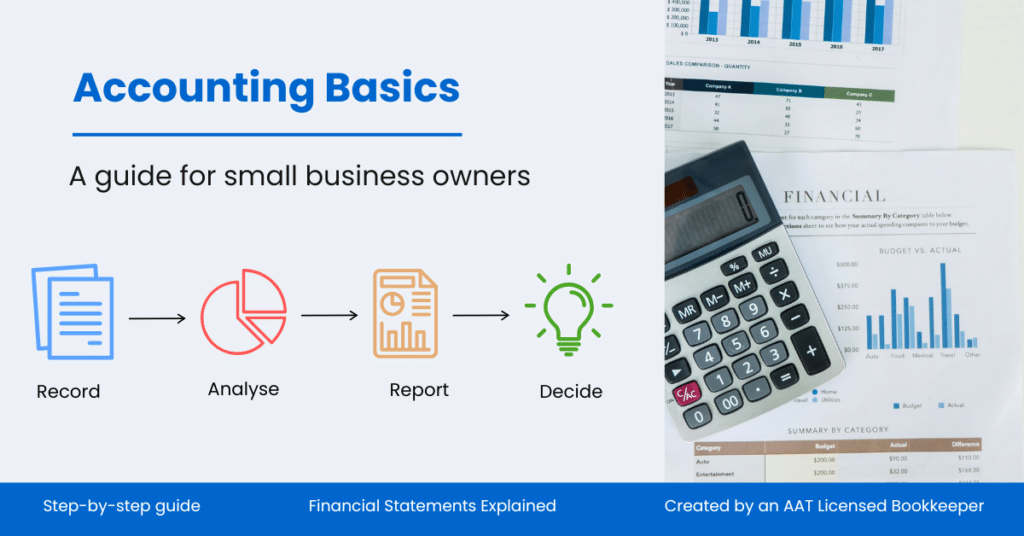
This beginner’s guide explains the basic accounting concepts in simple English, covering the key accounting concepts every small business owner should know. You’ll learn how bookkeeping records become financial reports, what the main accounting statements show, and how accounting helps you understand the financial health of your business.
At a glance
- Basic accounting shows how your business is performing.
- It uses bookkeeping records to produce financial reports.
- Understanding the basics helps you make better business decisions.
- Modern accounting software automates many tasks but doesn’t replace understanding.
What is Accounting Basics?
Accounting is the process of collecting, organising and analysing financial information to understand how a business is performing. It uses the records created through bookkeeping to record business transactions and produce reports that help business owners make informed decisions.
Disclosure: This content may contain affiliate links, which means if you click on them, I may get a commission (without any extra cost to you).
Good accounting tells you whether your business is making a profit, how much money it owes, what it owns and whether it has enough cash to meet its financial commitments. It also provides the information needed to prepare tax returns, meet legal requirements and plan for future growth.
Modern accounting software can automate many accounting tasks, but understanding accounting is an important part of good financial management. Whether you use spreadsheets, cloud accounting software or employ a bookkeeper or accountant, knowing what your financial reports mean will help you manage your business with confidence.
Accounting vs Bookkeeping
Bookkeeping and accounting work together, but they have different purposes.

Bookkeeping Basics is the process of recording your day-to-day financial transactions, such as sales, purchases and payments. These records form the foundation of your accounts.
Accounting Basics takes those records and turns them into meaningful financial information. It involves preparing financial reports, analysing your business performance and helping you make informed decisions.
In simple terms:
Without accurate bookkeeping, your accounting reports will be unreliable. Equally, bookkeeping records on their own don’t tell you whether your business is profitable or financially healthy.
| Bookkeeping | Accounting |
|---|---|
| Records financial transactions | Analyses financial information |
| Focuses on daily records | Focuses on the bigger picture |
| Produces accurate records | Produces financial reports and insights |
For a more detailed explanation, read our guide to Bookkeeping Basics or Accounting vs Bookkeeping.

How does Bookkeeping become Accounting?
Bookkeeping records every financial transaction, but accounting is where those records are organised, checked and turned into useful information.
The accounting cycle usually follows these steps:
- Record financial transactions through bookkeeping.
- Categorise them using the chart of accounts.
- Check the records using a trial balance.
- Make any necessary accounting adjustments.
- Prepare the financial statements.
- Review the results to understand how the business is performing.
This process turns day-to-day bookkeeping records into reports that show your business’s financial position and help you make informed decisions.
Tip: Keep business and personal finances separate. Using a separate bank account for your business makes bookkeeping much easier. It helps you identify business income and expenses, reconcile your accounts and keep accurate records without having to sort through personal transactions.
The Chart of Accounts
A chart of accounts is the list of every account used to record business transactions. It groups similar transactions into categories such as sales, purchases, wages, rent and bank accounts. Every transaction is assigned to one of these accounts, making it possible to prepare accurate financial statements.
The Accounting Equation
The accounting equation is the foundation of modern accounting. It shows the relationship between what a business owns, what it owes and the owner’s investment in the business.
Assets = Liabilities + Owner’s Equity
Assets are everything the business owns, such as cash, equipment, stock and money owed by customers. Liabilities are the amounts the business owes, including loans, supplier invoices and taxes. Owner’s equity (also called capital) represents the owner’s share of the business after liabilities have been deducted from assets.
Every financial transaction affects at least two parts of the accounting equation, but the equation must always remain in balance.
Below are examples of how three different transactions work in the accounting equation.
| Transaction | Assets | Liabilities | Equity |
|---|---|---|---|
| Owner invests £5,000 | +£5,000 | — | +£5,000 |
| Borrow £2,000 | +£2,000 | +£2,000 | — |
| Buy equipment for £1,000 cash | No overall change | — | — |
Understanding the accounting equation makes it easier to see how financial transactions affect your business and explains why the balance sheet always balances.
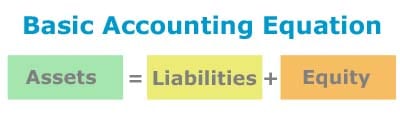
The accounting equation forms the foundation of double-entry bookkeeping and every set of financial statements.
Learn more: Accounting Equation.
Single Entry vs Double Entry Accounting
There are two main methods of recording financial transactions: single-entry accounting and double-entry accounting.
Single-Entry Accounting
Single-entry accounting is the simpler of the two methods. Each transaction is recorded only once, usually as money received or money paid. It works much like a bank statement or cash book and is suitable for some very small businesses with simple finances.
However, because it only records one side of a transaction, it provides limited financial information and cannot produce a complete balance sheet.
Double-Entry Accounting
Double-entry accounting records every transaction twice, with one entry as a debit and the other as a credit. This ensures the accounting equation always remains balanced and provides a complete record of the business’s finances.
For example, if a business buys equipment using money from its bank account, the equipment account increases while the bank account decreases. Recording both sides of the transaction keeps the accounts balanced.
Double-entry forms the basis of modern accounting and is used by accounting systems such as Xero and QuickBooks. It produces more accurate financial records and makes it possible to prepare financial statements such as the profit and loss account and balance sheet.
In double-entry, debits increase assets and expenses, while credits increase liabilities, income and owner’s equity. Every transaction includes at least one debit and one credit, ensuring the accounts always remain balanced.
| Single-Entry Accounting | Double-Entry Accounting |
|---|---|
| Records each transaction once | Records every transaction twice |
| Suitable for simple record keeping | Provides a complete accounting system |
| Limited financial reporting | Produces accurate financial statements |
| Often used with basic cash books or spreadsheets | Used by accounting software and limited companies |
Learn more: Single-Entry vs Double-Entry Bookkeeping.
The Main Financial Statements Explained
The main financial statements produced by accounting are the profit and loss account, balance sheet and, for many businesses, the cash flow statement. Together, they show profitability, financial position and cash movements, and show the overall financial health.
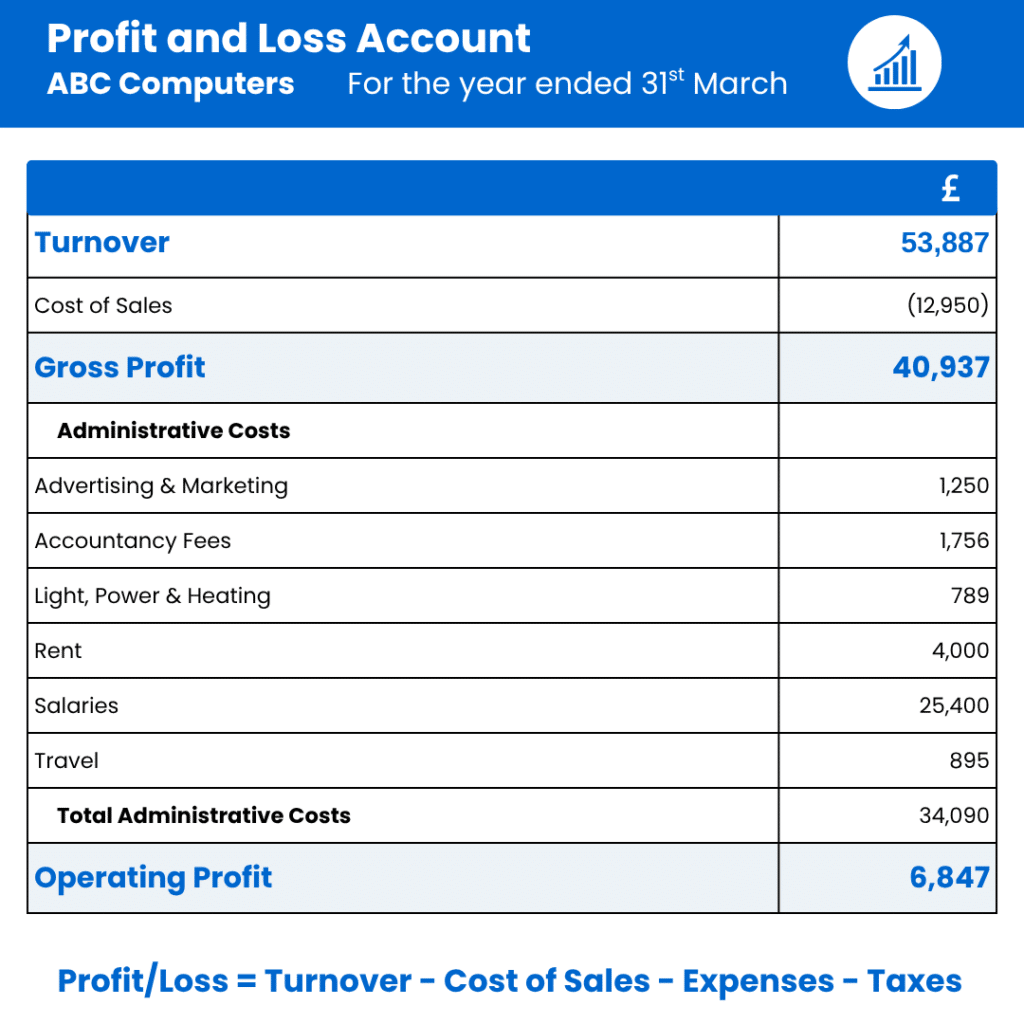
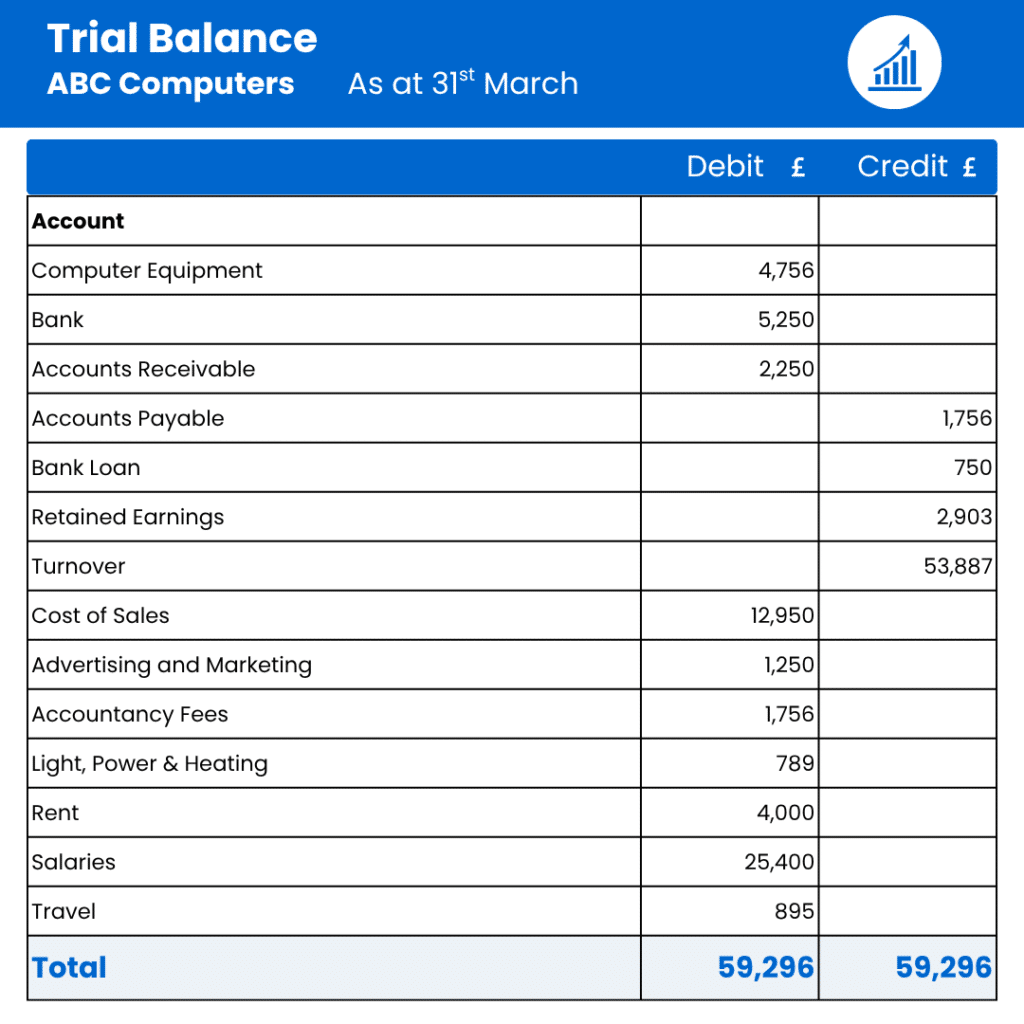
The example financial statements in this guide all use the same fictional business, ABC Computers. The figures are linked so you can see how information from the trial balance is used to prepare the profit and loss account and balance sheet. Following the same business through each example makes it easier to see how the different accounting reports work together.
Profit and loss statement (Income statement)
The profit and loss statement (P&L), also known as the income statement, summarises your income and expenses over a period, such as a month, quarter or year. It shows whether your business has made a profit or a loss.
The report starts with your sales or turnover (gross profit), then deducts the cost of sales and other expenses for running the business, such as stock, wages, rent, utilities and other operating expenses. The amount left is your net profit or net loss.
Business owners use the profit and loss account to see whether the business is growing, identify areas where costs are increasing and measure profitability over time. Comparing reports from different periods can help you spot trends and make better business decisions.
Balance Sheet
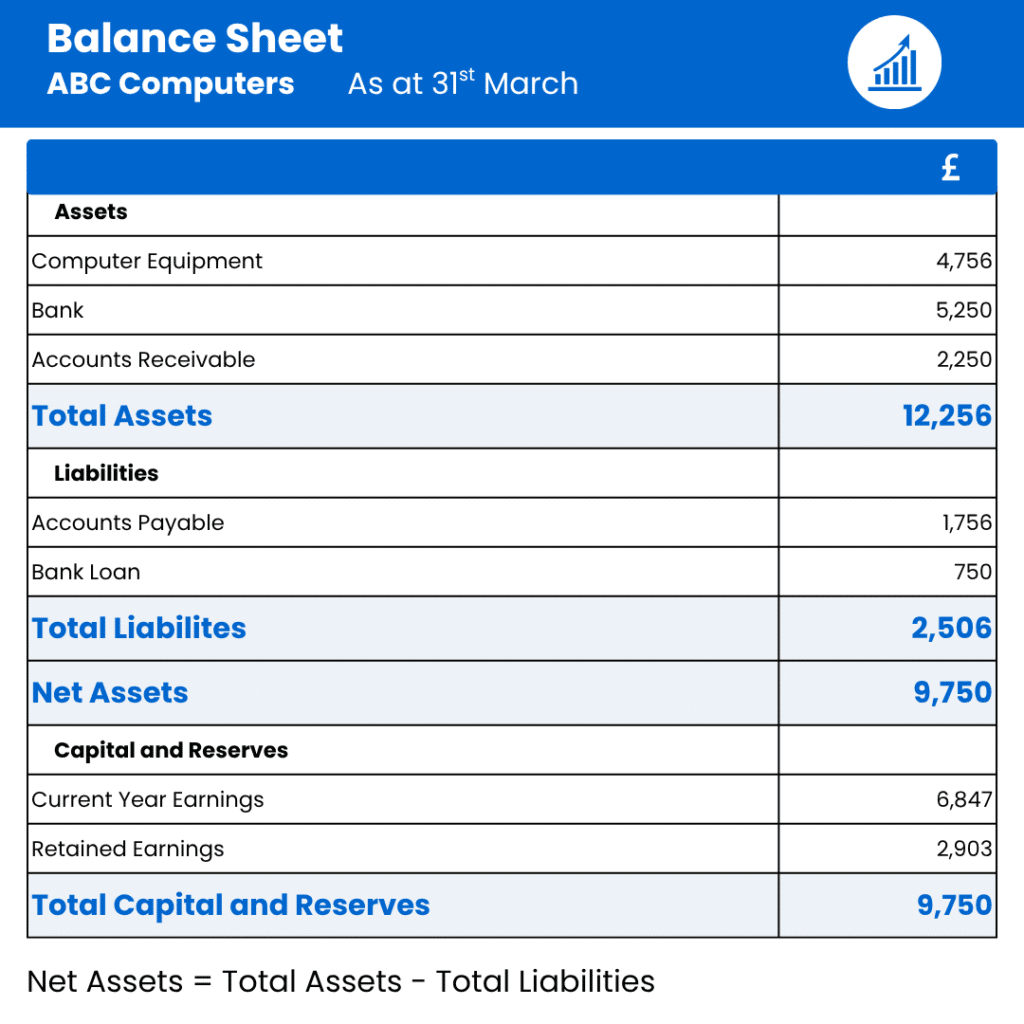
The balance sheet is a snapshot of your business at a specific date. It shows what your business owns (assets), what it owes (liabilities) and the owner’s equity.
Asset accounts include items such as money in the bank, unpaid customer invoices, stock and equipment. Liability accounts include supplier invoices, loans and taxes that are still to be paid. The difference between the two represents the owner’s interest in the business – Equity accounts.
Unlike the profit and loss account, which covers a period of time, the balance sheet shows your financial position on a single day. It helps you understand how financially stable your business is and whether it has enough assets to meet its obligations.
The balance sheet uses the same accounting equation explained earlier, but rearranged. Assets − Liabilities = Equity. In this example, £12,256 − £2,506 = £9,750, which equals the business’s capital and reserves.
Cash Flow Statement
The cash flow statement shows how cash moved into and out of your business during an accounting period. Unlike the profit and loss account, it records the actual movement of cash rather than when income is earned or expenses are incurred.
The statement is normally divided into three sections:
- Operating activities: Cash generated from normal business operations, such as customer payments and supplier costs.
- Investing activities: Cash spent on or received from buying and selling long-term assets, such as equipment.
- Financing activities: Cash received from or paid to owners and lenders, including loans and dividends.
A cash flow statement helps explain why your bank balance has changed over the accounting period and whether your business is generating enough cash from its day-to-day activities. It is particularly useful alongside the profit and loss account and balance sheet, as a profitable business can still experience cash flow problems.
| Financial Statement | Shows | Answers |
| Profit and Loss | Income, cost of sales, expenses and profit or loss | Is my business making a profit |
| Balance Sheet | Assets, liabilities and equity | What is my business worth today |
| Cash Flow Statement | Cash received and paid during the period | Where did my cash come from and where did it go? |
Larger businesses often prepare management accounts to help with budgeting and decision-making throughout the year.
What about the Trial Balance?
The ABC Computers trial balance below contains the account balances used in the example financial statements above. The income and expense accounts are used to prepare the profit and loss account, while the asset, liability and capital balances feed into the balance sheet.

Working Capital
Working capital shows whether a business has enough short-term assets to cover its short-term debts. It is calculated using figures from the balance sheet:
Working Capital = Current Assets − Current Liabilities
For example, if a business has £20,000 in current assets and £12,000 in current liabilities, it has working capital of £8,000.
Positive working capital generally means the business is in a better position to pay its day-to-day bills as they fall due. However, working capital is not the same as cash. Current assets can include stock and money owed by customers so that a business can have positive working capital but still experience cash flow problems.
Cash vs Accrual Accounting
There are two main methods of accounting: cash accounting and accrual accounting. The difference is when you record income and expenses.
Cash Accounting
Cash accounting records income when you receive payment and expenses when you pay them. It is simple to use and reflects the money moving through your bank account.
For most UK sole traders completing a Self Assessment tax return, cash accounting is the default method. However, you can choose to use the accrual basis instead if it better suits your business.
Accrual Accounting
Accrual accounting records income when it is earned and expenses when they are incurred, regardless of when money changes hands. This provides a more accurate picture of your business’s financial performance because it matches income with the related expenses.
Limited companies must prepare their accounts using the accrual basis, as it is required under HMRC and UK accounting standards for preparing statutory accounts.
Which Method Is Right for You?
| Cash Accounting | Accrual Accounting |
|---|---|
| Default for most sole traders completing Self Assessment | Used by limited companies and many larger businesses |
| Records money when it is received or paid | Records income and expenses when they are earned or incurred |
| Simpler to understand and maintain | Gives a more complete picture of business performance |
| Closely reflects your bank balance | Produces more accurate financial statements |
If you’re unsure which method to use, speak to your accountant or bookkeeper before preparing your accounts.
Cash Accounting vs Accrual accounting example
| December | January | |
|---|---|---|
| Work completed | ✓ | |
| Customer pays £1,200 | ✓ | |
| Cash accounting | £0 | £1,200 income |
| Accrual accounting | £1,200 income | £0 |
Cash accounting records the income when the customer pays in January.
Accrual accounting records the income when the work is completed in December.
Learn more: Cash vs Accrual Accounting.
Cloud Accounting Software
Accounting software has transformed the way businesses manage their finances. Instead of recording transactions manually, modern software automates many accounting tasks, saving time and reducing the risk of errors.
Most cloud software can:
- import transactions directly from your business bank account;
- categorise income and expenses;
- create and send invoices;
- reconcile bank accounts;
- calculate VAT;
- produce financial reports, including the profit and loss account and balance sheet.
Many small businesses choose cloud accounting software such as Xero or QuickBooks because it automates time-consuming bookkeeping tasks, reducing manual data entry and providing up-to-date financial information.
Features such as automatic bank feeds make bank reconciliation much quicker by comparing your records with your bank statement to ensure every transaction has been recorded correctly. As your business grows, bookkeeping software also makes it easier to manage your accounts and share information with your bookkeeper or accountant.
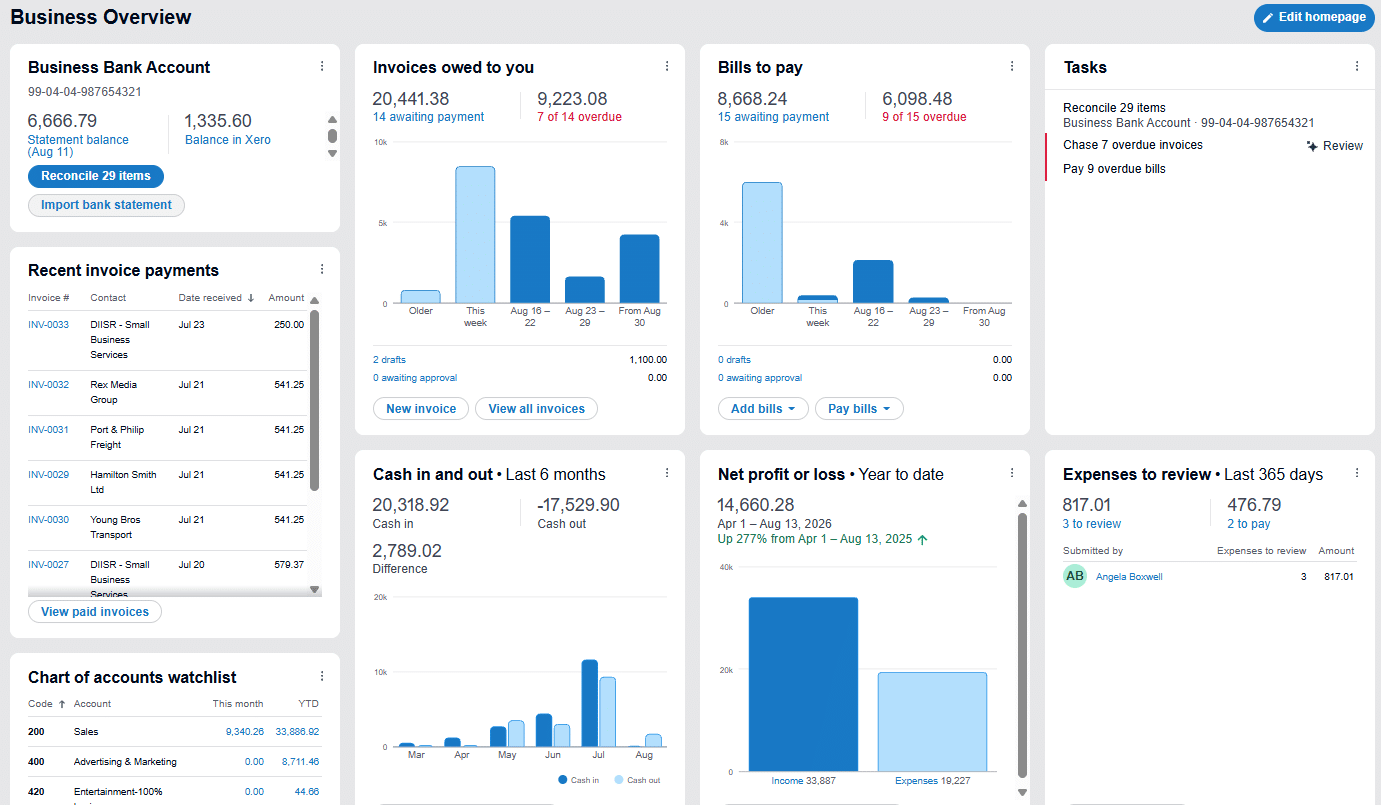
Although bookkeeping software automates much of the process, it still relies on accurate information. Choosing the correct account, checking transactions and reviewing your financial reports remain important to ensure your accounts are correct.
Many businesses start with a spreadsheet before moving to software as they grow. The right choice depends on the size of your business, the number of transactions and your reporting needs.
Learn more: Cloud Accounting Software.
Accounting and Taxation
Keeping accurate records makes it easier to calculate and budget for tax payments. Your accounts provide the financial information needed to complete tax returns, claim allowable business expenses and meet HMRC reporting requirements.
Depending on your business structure, you may need to prepare information for:
- Self Assessment if you’re a sole trader or partner.
- Corporation Tax if you run a limited company.
- VAT returns if your business is VAT registered.
- Making Tax Digital (MTD) if you’re required to keep digital records and submit information electronically to HMRC.
Maintaining accurate records throughout the year helps reduce errors, avoids last-minute stress and ensures you have the information needed when it’s time to submit your tax returns.
Learn more: Self Assessment, Corporation Tax, VAT and Making Tax Digital.
Common Basic Accounting Terms
When learning accounting, you’ll come across several technical terms. Understanding the most common accounting terminology will make it easier to read financial reports and communicate with your bookkeeper or accountant.
| Term | Meaning |
|---|---|
| Assets | Things your business owns, such as cash, equipment and stock. |
| Liabilities | Money your business owes, including loans and supplier invoices. |
| Capital (Equity) | The owner’s investment in the business after liabilities are deducted from assets. |
| Revenue (Income) | Money earned from selling goods or providing services. |
| Expenses | The day-to-day costs of running your business. |
| Profit | The amount left after expenses have been deducted from income. |
| Loss | When expenses are greater than income. |
| Debits and Credits | The two sides of every double-entry accounting transaction. |
| Accounts Receivable | Money owed to your business by customers. |
| Accounts Payable | Money your business owes to suppliers. |
| Depreciation | Spreading the cost of an asset over its useful life. |
| Trial Balance | An internal report used to check that the accounts balance before preparing the financial statements. |
Understanding these terms will help you read financial statements with confidence and make it easier to understand more advanced accounting basics.
Learn more: Basic Accounting Terms.
Frequently Asked Questions
Conclusion
Understanding the accounting basics helps you do much more than meet your tax obligations. It gives you the knowledge to understand your financial statements, monitor your business performance and make informed decisions based on accurate financial information.
Whether you use spreadsheets, cloud accounting software or work with a bookkeeper or accountant, knowing the key accounting principles will help you stay in control of your finances. As your business grows, this understanding will make it easier to manage cash flow, plan for the future and meet your legal and tax responsibilities with confidence.
Related Pages
Bookkeeping Basics
Accounting Cycle
Accounting Equation
Accounting Ratios
Working capital
