

Home Office Expenses – What Can Self-Employed People and Employees Claim?
Learn which home office expenses you can claim when working from home, whether you’re self-employed or employed, including HMRC rules, calculation methods and available tax relief.
Working from home can save money on travel, but it may also increase your household bills. Whether you’re self-employed or employed, you may be able to claim certain home office expenses, but the rules differ.
This guide explains what you can claim, how to calculate your expenses and the tax relief available. It also includes a free home office expenses calculator and Excel template to help you work out your claim.
Use of Home as an Office – Self-Employed
You can claim the business share of your home running costs using either HMRC’s simplified expenses flat rates or a reasonable proportion of your actual costs.
Disclosure: This content may contain affiliate links, which means if you click on them, I may get a commission (without any extra cost to you).
To use HMRC’s simplified expenses method, you must spend at least 25 hours a month carrying out business activities from home.
If you are calculating the full cost, we have provided an Excel template. This article includes complete instructions, examples, and downloads.
Home office costs form part of your allowable business expenses and reduce your taxable business profit.
Which method should I choose?
Simplified expenses involve fewer calculations. If you work from home for at least 25 hours a month, use HMRC’s monthly flat rates and keep a record of your hours.
The actual-cost method may give you a larger deduction, depending on your household bills and business use. Keep the relevant bills and a reasonable calculation of the business proportion. Compare the total allowable claim under each method, including any costs you can claim separately, and avoid counting the same expense twice.
Use of Home as an Office – Employees
The rules for employees differ from those for self-employed people. From 6 April 2026, employees can no longer claim tax relief directly from HMRC for additional household expenses incurred while working from home. This change does not affect allowable home-office expenses for sole traders.
Payments from your employer
Your employer can still reimburse qualifying additional household costs under a homeworking arrangement. They can pay £6 a week, or £26 a month for monthly-paid employees, without needing evidence of the actual costs.
If your employer pays more, they must keep evidence showing that the payment covers your additional household expenses. These payments cover extra costs such as heating and electricity, rather than your ordinary rent or mortgage payments.

Claims for previous tax years
You may still qualify for tax relief for earlier tax years if you met HMRC’s conditions. You generally needed to work from home because your job required it, rather than because you preferred to.
For eligible claims, the £6 weekly amount reduces your taxable income. It is not a £6 refund: a basic-rate taxpayer receives £1.20 a week in tax relief.
Check the eligibility rules and claim deadlines on GOV.UK before submitting a claim.
Use of Home as an Office Flat Rate
The following guidance applies to self-employed people. HMRC’s monthly flat rate depends on how many hours you work from home.
| Hours of business use per month | Flat rate per month |
| 25 to 50 | £10 |
| 51 to 100 | £18 |
| 101 and more | £26 |
A builder works from home ordering materials and preparing quotations: 30 hours a month for 10 months and 55 hours a month for two months. The annual claim is (10 × £10) + (2 × £18) = £136.
Include this amount as a business expense on your Self Assessment tax return.
What can I claim alongside the flat rate?
HMRC’s simplified expenses flat rate covers household running costs, including heating, lighting and electricity.
You can also claim the business proportion of telephone and broadband costs separately. HMRC lets you claim an identifiable business share of fixed household costs, such as Council Tax, home insurance, and mortgage interest.
Keep records of these costs and use a reasonable method to calculate the business proportion. You cannot claim the same expense twice.

Enter the number of months you worked from home within each hours band.
Use the Government Simplified Expenses checker to see if you are eligible. The checker requires the following information:
- Vehicle, if used for business
- Using home for business or living on your business premises
- The average number of hours a month working from home
- The cost of your home you expect to claim as a business expense. Use our spreadsheet below to calculate this.
The calculation will estimate both the simplified and percentage-based expense claim.
Actual Costs Method
If you’re self-employed, you can claim a reasonable business proportion of your actual household costs instead of using the simplified expenses flat rate.
Calculate your claim based on the space you use for business, how often you use it and the nature of each expense.
Shared rooms and occasional homeworking
You do not need a dedicated office to claim homeworking expenses. If you use a shared room, such as a dining room, claim only the costs that reasonably relate to business use. Under the actual-cost method, consider the space you use and how long you use it for business.
If you work from home for fewer than 25 hours in a month, you cannot use the simplified homeworking rate for that month, but you may still claim a reasonable business proportion of actual costs. Keep a note of your working pattern and how you calculated the claim.
Which household costs can I include?
Use your bills and statements to identify the following costs.
Mortgage – Claim the business proportion of mortgage interest, excluding capital repayments. Check your mortgage statement for the interest charged.
Rent – Include the business proportion of your rent. Check whether your tenancy agreement allows you to run a business from home.
Council Tax – You can claim part of your council tax as a home office expense. You may need to pay business rates if you use your home as more than an office. There are rules, and it is worth checking on https://www.gov.uk/introduction-to-business-rates/working-at-home
Lighting and Heating – Check your utility bill for the amount spent on gas and electricity. Include utilities in your calculation if self-employed.
Telephone and Internet Costs – Base your claim on business use, rather than the proportion of your home used for work. For example, if broadband costs £30 a month and you use it 50% for business, claim £15.
You can claim the full cost of a telephone line used solely for business.
Property Repairs – You may claim a reasonable business proportion of repairs and maintenance that affect the whole property, such as fixing a leaking roof.
If repairs relate specifically to the area you use for business, calculate the allowable amount based on its business use. You cannot claim repairs to areas used solely for private purposes.
You cannot claim the cost of home improvements, extensions or alterations as ordinary home office expenses.
Insurance – You can claim the cost of insurance taken out wholly for business purposes. You may also claim an identifiable business proportion of your home insurance, where appropriate. Do not claim the same cost twice.
Home Office Deduction Worksheet Excel
Our home office deduction worksheet in Excel is an easy-to-use template. The download is available at the bottom of this page.

Instructions for the Home Office Expenses Template
- Download the Excel template and save a copy before entering your figures.
- Use the list of allowable household expenses above to identify your costs and calculate the amount for each expense.
- Enter the average number of days you use your home for business each week.
- Enter the number of living rooms and bedrooms in your home, including any study or home office. Exclude bathrooms, kitchens and hallways.
- Enter the number of rooms you use for business. For shared rooms, enter the proportion used for business, such as 0.5 for 50%. Enter 1 for a room used entirely for business.
- The spreadsheet automatically calculates your monthly and annual home office expenses.
Record the calculated business expenses in your accounting software.
Important: Using a room exclusively for business may affect Private Residence Relief from Capital Gains Tax when you sell your home. Using a room for both personal and business purposes can help avoid this issue.
Below is an example of the home office expenses template for taxes:
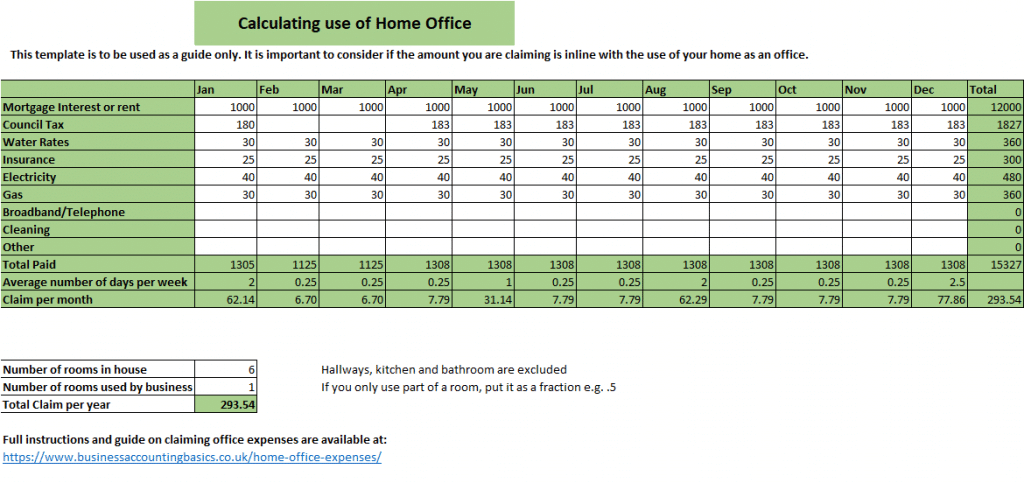
The above example shows the following:
- Monthly rent of £1,000 before calculating the business proportion. If you have a mortgage, claim only the business proportion of mortgage interest.
- The Direct Debit for council tax (only pay for 10 months)
- Direct Debit for insurance, gas and electricity
- 6 Rooms in the house (3 bedrooms, lounge, dining room and study)
- One room used as a home office, with some personal use outside working hours.
- The total claimed for the year is £293.54
Important: This template provides an estimate based on the number of rooms and days worked from home. Your claim must reflect your actual business use. Consider the hours worked, space used, and nature of each expense when deciding whether the calculated amount is reasonable.
Claiming Other Business Expenses
You may also claim allowable business expenses you pay personally. Our guide and expense template can help you record them.
If you use your vehicle for business use, we have created a simple mileage log.

Free Home Office Expenses Template
By downloading our free templates, you agree to our licence agreement, allowing you to use the templates for your own personal or business use only. You may not share, distribute, or resell the templates to anyone else in any way.


If you are unsure what to claim, ask an accountant to check your expenses and help you choose a suitable method.
Claiming Home Office Expenses: Summary
If you are a sole trader, compare HMRC’s simplified flat rates with the business proportion of your actual costs. Choose a suitable method and keep records to support your claim.
If you are an employee, check whether your employer reimburses qualifying homeworking costs. You may also qualify for tax relief for earlier tax years if you met HMRC’s conditions.
Browse our free Excel bookkeeping templates.
