Understanding Work in Progress Accounting
Introduction
If you run a business that takes on longer projects — such as building services, manufacturing goods, or providing consultancy — you’ve probably heard the term Work in Progress (WIP).
Put simply, WIP refers to all the work you’ve started but not yet completed. For example:
- A builder partway through a loft conversion
- A manufacturer with products still on the production line
- A designer is halfway through creating a website
From an accounting point of view, WIP matters because it represents money already tied up in materials, labour, and overhead costs that haven’t yet become a finished product or service you can invoice for.
Disclosure: This content may contain affiliate links, which means if you click on them, I may get a commission (without any extra cost to you).

Tracking WIP properly helps you:
- Show a more accurate picture of your finances
- Avoid overstating profits or assets
- Plan with better cash flow and control
In this post, we’ll look at what WIP really means, how it appears in your accounts, common ways of dealing with it, and some practical tips to keep it under control.
Work In Progress Definition
Work in Progress (WIP) refers to the value of partially completed products, services, or projects that are not yet finished or invoiced. It includes the costs of materials, labour, and overheads incurred to date in a job or production process.
Why Track WIP?
Many businesses overlook WIP, but it is essential to accurate accounting.
If you record all the contract income before the work is finished, you risk overstating profits. But if you ignore WIP completely, you might understate the value of your business.
Knowing how much money is tied up in incomplete work also helps with cash flow planning. It tells you how much you’ve invested in a project and how much more you’ll need before you can get paid.
WIP also acts as a control tool. By comparing actual costs with expected progress, you can identify when a job is running over budget and take action before it gets out of control.

WIP on the Company’s Balance Sheet
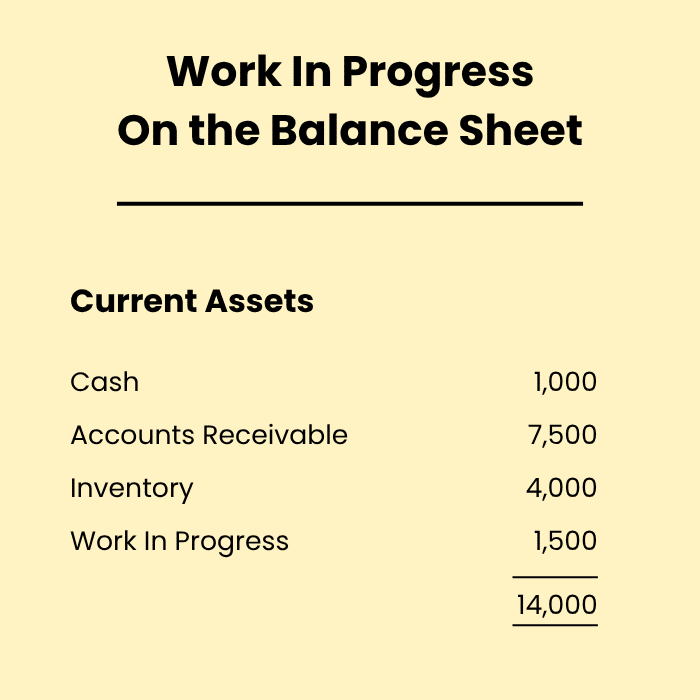
When you look at your balance sheet, you’ll see three main sections: assets (what you own), liabilities (what you owe), and equity. Work in Progress (WIP) is classed as a current asset because it represents what you have already created but not yet invoiced or converted into cash.
In other words, WIP sits alongside things like accounts receivable and inventory—it’s part of the resources your business expects to turn into cash within the next 12 months. By recording WIP as an asset, your balance sheet accurately reflects the real value tied up in ongoing work, rather than just showing costs that make the business appear less profitable than it actually is.
Accounting for Work in Progress
Accounting for work in progress involves carefully calculating the costs of raw materials, labour, and overhead costs that are incurred during production. These costs reflect the value of products or services and must be tracked accurately.
Because a work-in-progress is an inventory account, it requires accurate valuation to ensure accurate financial reporting. If the WIP is overstated or understated, the financial statements will not accurately reflect the business’s actual performance.
The calculation of work in progress can sometimes be time-consuming, but businesses need to calculate the value of their unfinished products or services.
Common Methods of Accounting for WIP
Below are some of the common ways to calculate WIP.
Job Costing
Job costing involves tracking the costs associated with each job or contract. All materials, labour, and overheads are assigned directly to that job. The total at the end of the reporting period is recorded as Work in Progress. It is common in construction, trades, and manufacturing, where every job is unique.
Percentage of Completion
The percentage-of-completion method recognises revenue and profit as the job progresses. Progress is typically measured by comparing the costs incurred so far with the total estimated costs, or by evaluating the physical completion of the work. It is typically used for longer-term jobs where progress can be measured reliably.
Completed Contract
Under a completed contract, no revenue or profit is recognised until the entire job is finished. It’s a simple approach and avoids estimating progress, but it can make profits look uneven from year to year. It is often used for smaller jobs or when measuring progress accurately is challenging.
Accounting Software Best Deals

XERO – 90% Discount for 6 Months – Cloud accounting, unlimited users, bank feeds, MTD compatible

QuickBooks – 90% off for 7 Months – Sole traders, easy to use, MTD-compatible

Tide – Free with Tide Bank Account – All your banking and accounts in one place, MTD compatible
Work in Progress Examples
Here are three examples of Work in Progress:
Example 1: House Extension (Builder) Percentage of Completion
A small building firm takes on an £80,000 house extension.
By the end of the financial year, the team has:
- Spent £20,000 on materials (bricks, timber, cement).
- Spent £10,000 on direct labour (builders’ wages).
- Allocated £5,000 of overheads (equipment hire, fuel, site costs).
The total costs to date are £35,000, and the job is approximately 50% complete.
In this case, the WIP recorded in the accounts would be £40,000 (50% of the whole contract), shown as an asset on the balance sheet. The remaining costs and revenue will be recognised upon completion of the job.
Example 2: Consultancy Assignment (Consultant) – Job Costing
A consultancy firm agrees a £20,000 contract to deliver a business strategy for a client. The work is expected to take three months.
By the end of the first month, the consultant has:
- Spent 40 hours on research and workshops (valued at £4,000).
- Incurred £1,000 in travel and software costs.
The total costs are £5,000. The WIP recognised at this stage would be £5,000.
Example: Small Manufacturer
A small furniture maker is producing 50 wooden tables. Each table will sell for £400, giving a total of £20,000 in sales once they are finished.
By the end of the month, the production process will be halfway:
- Raw materials used so far: £6,000 worth of timber, screws, and varnish
- Direct labour: £4,000 in wages for the joiners
- Factory overheads: £2,000 for rent, power, and machine use
This totals £12,000 spent on the partially completed products. The tables are not finished yet, so they can’t be counted as finished goods. Instead, they are treated as £12,000 in-process inventory (work-in-progress).
Tracking WIP with Xero
While Xero’s system doesn’t automatically calculate WIP, the Xero Projects add-on is a powerful tool for tracking jobs at various stages and monitoring costs as they accrue. It’s especially useful if you work on house extensions, consultancy assignments, or manufacturing jobs.
Xero helps track the company’s inventory, including raw materials. You can record purchases, monitor stock levels, and assign costs to jobs or sales. This ensures accurate accounts and facilitates the smooth flow of raw materials into work-in-progress and the final product.
Work In Progress Conclusion
Managing Work in Progress properly ensures that your accounts accurately reflect the real health of your business. Whether you’re tracking building jobs, consultancy work, or production using raw materials, tools like Xero can help you stay accurate and in control.
Work In Progress FAQ
What’s the difference between WIP and inventory asset?
WIP is part of the inventory. Inventory includes raw materials, in-process items, and finished goods. WIP specifically refers to items that are still in production or jobs that are partly complete.
Why is WIP important for small businesses?
It prevents profits from being overstated or understated, helps manage cash flow, and gives a clearer picture of how much value is tied up in part-finished work.
Is WIP an asset or an expense?
WIP is treated as a current asset on the balance sheet until the work is finished. Once revenue is recognised, the related costs move to the profit and loss account as expenses.
What is Work in Progress in Accounting?
Work in Progress (WIP) is the value of jobs, services, or products that are part-finished at the end of a period. It includes costs such as materials, labour, and overheads that haven’t yet been converted into finished goods or invoiced services.