


Balance Sheet: A Beginner’s Guide
Understand what a balance sheet shows and how the figures fit together.
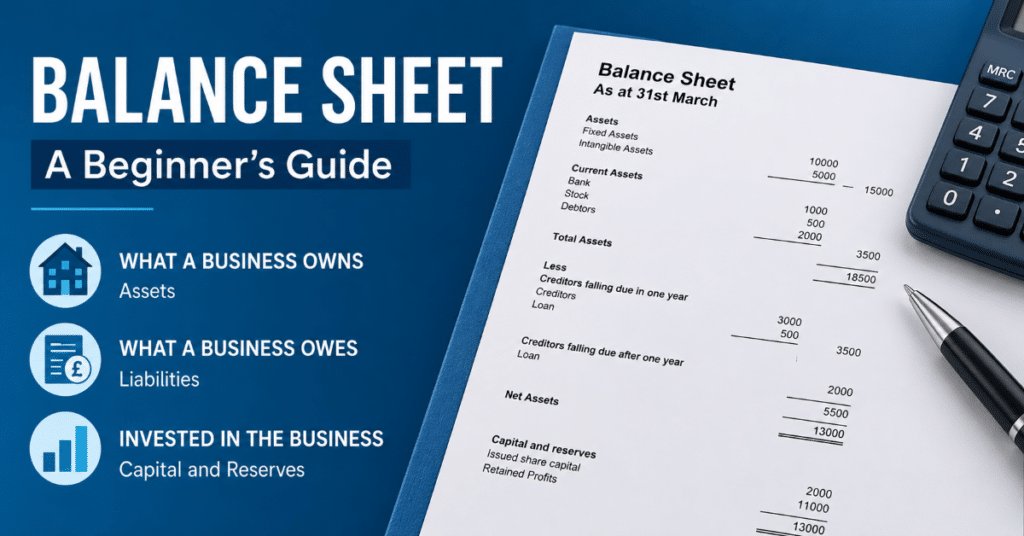
A balance sheet shows what a business owns, what it owes and the amount invested in the business at a specific date. This guide explains the main sections of a balance sheet, including assets, liabilities and capital, with a simple example to help you understand the figures.
Balance Sheet at a Glance
- A balance sheet is one of the financial statements and shows what a business owns and owes at a specific date.
- The three main parts are assets, liabilities and equity (capital).
- Assets include items such as cash, stock, equipment and money owed by customers.
- Liabilities are amounts the business owes, including loans, credit cards and supplier bills.
- The basic balance sheet equation is Assets = Liabilities + Equity.
- Unlike a Profit and Loss Statement, which covers a period of time, a balance sheet is a snapshot on one particular date.
- Accounting software can produce a balance sheet automatically, or you can use a balance sheet template if you keep your records in a spreadsheet.
What is a Balance Sheet
A balance sheet is one of the financial statements and shows what a company owns, what it owes and the amount invested in the business at a specific date. It is called a balance sheet because the figures on each side of the accounting equation must balance.
The balance sheet is divided into three main areas:
Disclosure: This content may contain affiliate links, which means if you click on them, I may get a commission (without any extra cost to you).
- Assets – what the company owns or is owed, such as equipment, stock, money in the bank and unpaid customer invoices (accounts receivable).
- Liabilities – money the business owes, including supplier bills (accounts payable), loans and credit cards.
- Equity or capital – the amount left in the business after liabilities are deducted from assets.
Unlike a Profit and Loss Statement, which shows income and expenses over a period, a balance sheet shows the position of the business on one particular date. For example, a balance sheet might be prepared as at 31 March or at the end of the financial year.
The Balance Sheet Equation
The balance sheet is based on a simple accounting equation:
Assets = Liabilities + Equity
This means everything the business owns or is owed must be funded either by money it owes to others or by the owner’s or shareholders’ investment and accumulated profits.
For example, if a business has total assets of 10,000 and liabilities of 4,000, its equity is 6,000:
10,000 = 4,000 + 6,000
The equation can also be rearranged to show the net assets of the business:
Assets − Liabilities = Equity
If the two sides do not agree, an error exists in the accounting records that must be found and corrected.
What is Included in a Balance Sheet
A balance sheet is made up of assets, liabilities and equity (capital). These are usually divided into smaller categories so it is easy to see where the figures come from.
Assets
The company’s assets are items the business owns or amounts owed to the business. They are divided into two main groups:
- Fixed assets (long-term assets) – items kept and used by the business for more than a year, such as equipment, vehicles, machinery and property.
- Current assets – items expected to be used, sold or easily converted into cash within a year. These include stock, money in the bank and amounts owed by customers (debtors).
Liabilities
Liabilities are amounts the business owes to other people or organisations. They are normally split between:
- Current liabilities – amounts due within one year, including supplier bills (creditors), overdrafts, taxes owed, short-term loans and money the company owes to a director through a Director’s Loan Account.
- Long-term liabilities – amounts due after more than one year, such as longer-term bank loans.
Equity or Capital
Equity is what remains after all the business’s liabilities are deducted from its assets. Depending on the type of business, this may include money invested by the owner or shareholders and retained earnings (profit) in the business.
The next example shows how these sections appear together on a simple balance sheet.
Simple Balance Sheet Example
The simple balance sheet example below shows how assets, liabilities and equity fit together and how the figures balance.
Assets | ||
1000 | ||
100 | ||
Total Fixed Assets | 900 | |
Current Assets | ||
250 | ||
150 | ||
Bank | 1250 | |
Total Current Assets | 1650 | |
Total Assets | 2550 | |
Current Liabilities | ||
300 | ||
Loan | 200 | |
Credit card | 75 | |
Total Liabilities | 575 | |
Net Assets | 1975 | |
Equity | ||
Capital | 200 | |
1775 | ||
Total Equity | 1975 |
In the example above, the business has total assets of 2,550 and liabilities of 575, leaving net assets of 1,975. This matches the total equity of 1,975, so the balance sheet balances.
The figures on a balance sheet change as transactions are entered into the accounting records. For example, buying equipment increases fixed assets, while paying a supplier reduces both the bank balance and the amount owed to creditors.
Accounting software records these changes and produces an up-to-date balance sheet from the transactions entered. If you keep your records in a spreadsheet, you can use our free balance sheet template to prepare one manually.

How to Read a Balance Sheet
A balance sheet can look complicated at first, but it becomes easier to understand when you work through it one section at a time. The example below uses a typical UK balance sheet format and shows the position of the business as at 31 March.

Start at the top with the assets. These are split between fixed assets, which the business keeps and uses, and current assets such as bank, stock and debtors.
Next are the liabilities, shown here as creditors due within one year and amounts due after more than one year. Deducting these amounts from the assets leaves net assets of 13,000.
Finally, look at capital and reserves. In this example, issued share capital of 2,000 plus retained profits of 11,000 gives 13,000. This agrees with the net assets, so the balance sheet balances.
When reviewing your own balance sheet, compare it with earlier periods and look at the individual figures. This can help you spot changes in cash, amounts owed by customers, debts and retained profits.
When is a Balance Sheet Needed?
Limited companies prepare a balance sheet as part of their annual accounts. The balance sheet shows the company’s assets, liabilities and equity at the end of its financial year and forms part of the accounts filed with Companies House.
Sole traders do not normally need to file a balance sheet, but preparing one can still be useful. It can help you track business assets, outstanding debts, and how much capital is tied up in the business.
A balance sheet may also be requested when applying for business finance or when an accountant, lender or potential investor needs to see the company’s financial position.
Balance Sheet vs Profit & Loss
A balance sheet and Profit and Loss Statement, also known as an Income Statement, show different parts of a business’s accounts. The main difference is the period they cover: a balance sheet shows the company’s financial position at a specific point in time. In contrast, the Profit and Loss Statement shows income, expenses and profit over a period of time.

For example, the Income Statement above covers the year ended 31 March, whereas a balance sheet would be prepared as at 31 March.
The Profit and Loss Statement shows whether the business made a profit or loss during the period. The balance sheet shows its assets, liabilities and equity at the end of that period.
The two reports are connected. Profit earned by the business increases retained profits in the equity section of the balance sheet, while a loss reduces them.
For more detail on income, expenses and profit, see our guide to the Profit and Loss Statement.
How to Create a Balance Sheet
If you use accounting software such as Xero, QuickBooks or Sage, the balance sheet is created automatically from the transactions recorded in your accounts. As long as your bookkeeping is up to date, you can run the report for any date and see the balances for your assets, liabilities and equity.

If you prepare your accounts manually, start by listing all the business assets and their balances. Next, list the liabilities and calculate the total amount owed. Deducting the liabilities from the assets gives the net assets of the business, which should agree with the capital or equity figure.
To produce an accurate balance sheet, check that your bank accounts are reconciled and that balances for items such as debtors, creditors, stock and loans are up to date. Incorrect or missing transactions will affect the figures.
For businesses using spreadsheets, our free balance sheet template provides a ready-made layout for entering the figures and calculating the totals.
Free Balance Sheet Template
If you don’t use accounting software, our free balance sheet template provides a simple way to prepare a balance sheet in Excel.
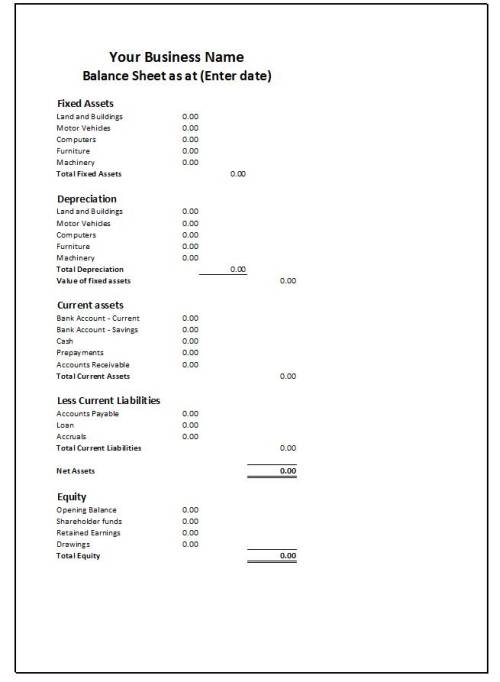
The template includes sections for fixed assets, current assets, liabilities and capital, with formulas to calculate the totals automatically. Enter your figures and check that the balance sheet balances when complete.
You can download the free Excel balance sheet template and find instructions for completing it on our Balance Sheet Template page.
Balance Sheet FAQ
Balance Sheets Conclusion
A balance sheet gives you a snapshot of what a business owns and owes at a specific date. Once you understand how assets, liabilities and equity fit together, the figures become much easier to read.
Whether you use accounting software or a spreadsheet, keeping your bookkeeping up to date is important if you want the balance sheet to be accurate. Use the report alongside your Profit and Loss Statement to understand what has happened during the year and where the business stands at the reporting date.
Related Pages on Business Accounting Basics
