

Depreciation accounting helps UK small businesses spread the cost of equipment, vehicles, and other long-term assets over the time they use them.
When a business buys an asset that will last for several years, it should not treat the full cost as a one-off expense. Instead, depreciation allocates the cost over the years the business uses the asset. This approach gives a more realistic view of ongoing business costs and supports better financial decision-making.
This guide explains how small businesses apply depreciation in practice, including what to depreciate, how to decide on useful life and salvage value, and how depreciation fits alongside UK tax rules.
Disclosure: This content may contain affiliate links, which means if you click on them, I may get a commission (without any extra cost to you).

What Is Depreciation in Accounting?
Depreciation spreads the cost of a long-term business tangible asset over the period the business expects to use it.
Businesses use depreciation because most assets wear out, become outdated, or lose value over time. By spreading the cost, the accounts reflect the ongoing cost of using the asset rather than concentrating the full cost in the year of purchase.
When you depreciate an asset, you make practical estimates about:
- How long will you use the asset
- How quickly will it lose value
- Whether it will have any value at the end of its life
These estimates form the basis for calculating depreciation for each asset.

Why Businesses Depreciate Assets
Depreciation helps business owners understand the true cost of running their business.
Rather than focusing only on cash spent, depreciation shows how assets contribute to costs over time. This supports better planning and more accurate performance measurement.
Businesses depreciate assets to:
- Understand the ongoing cost of using equipment and vehicles
- Plan for future replacements and upgrades
- Avoid distorted profits between different years
- Improve pricing and profitability decisions
- Support more realistic management accounts
Depreciation turns large one-off purchases into manageable annual costs that better reflect how the business actually operates.
How Depreciation Appears in the Financial Statements
Depreciation affects more than one part of your financial statements.
Understanding where depreciation appears helps business owners read their accounts more confidently and spot potential issues.
Profit and Loss Account (Income Statement)
Depreciation is an expense recognised in the profit and loss account.
This depreciation expense reduces your accounting profit for the period. Although depreciation does not involve a cash payment, it reflects the cost of using your assets to generate income.
Balance Sheet
The balance sheet depreciation shows the company’s assets at their original cost, less the depreciation charged to date.
This approach shows the remaining accounting value of each asset based on how much of its useful life the business has already used.
The balance sheet does not show depreciation for tax purposes. It only reflects depreciation used for accounting and management reporting.
What Assets Can Be Depreciated?
Businesses depreciate assets that they expect to use for more than one year, and that will lose value over time.
Common depreciable assets for UK small businesses include:
- Computers, laptops, and IT equipment
- Office furniture and fittings
- Machinery and production equipment
- Vans and business vehicles
- Tools and specialist equipment
If an item supports the business over several years and will wear out or become obsolete, you should normally treat it as a depreciable asset.
What Assets Cannot Be Depreciated?
Some items do not lose value through use in the same way and should not be depreciated.
Businesses normally do not depreciate:
- Land
- Stock and inventory
- Investments
- Assets held for resale
These items either do not wear out or are subject to different accounting treatment, so depreciation does not apply.
How to Choose the Expected Useful Life of an Asset (UK)
When you depreciate an asset, you must decide how long you expect to use it in your business.
You should base useful life on realistic business judgment, not tax rules. Consider:
- How often do you replace similar assets
- How quickly technology becomes outdated
- How intensively you use the asset
- Manufacturer guidance and warranties
Typical useful life ranges for small businesses include:
- Computers and IT equipment: 3 to 5 years
- Office furniture: 5 to 10 years
- Vehicles: Will depend on business
- Machinery and tools: 5 to 15 years
You should review useful lives if your business use changes significantly.
Residual (Salvage) Value Explained
Residual value is the amount you expect to recover when you stop using the asset.
When you set depreciation, you can estimate whether the asset will have resale, trade-in, or scrap value at the end of its useful life. If you expect to recover some value, you only depreciate the part of the cost you expect to use up.
For many small business assets, businesses set the salvage value to zero for simplicity. This avoids over-estimating resale values and keeps depreciation straightforward.

Accounting Depreciation vs Capital Allowances (UK)
Depreciation and capital allowances serve different purposes in the UK.
You use depreciation in your accounts to reflect the economic cost of using assets. HMRC does not allow depreciation as a tax deduction. Instead, HMRC uses capital allowances to calculate tax relief.
In practice:
- Depreciation affects your accounting profit
- Capital allowances affect your taxable profit
- The two figures will often differ
Capital allowances may include:
- Annual Investment Allowance (AIA)
- Writing Down Allowances
- Special rate pools for certain assets
Even though HMRC ignores depreciation for tax, you should still depreciate assets in your accounts to keep your financial information accurate and useful.
Depreciation Methods (Overview)
Businesses use different depreciation methods depending on how an asset loses value over time.
Most UK small businesses use simple, consistent methods that reflect how they use their assets in practice. If you want to see how different methods affect depreciation amounts, you can also use our free depreciation calculators to compare results and estimate annual charges.
Straight-Line Method
Straight-line depreciation spreads the cost evenly over the useful life of the asset.
This method works well for assets that provide similar value each year, such as:
- Office furniture
- Computers and IT equipment
- Fixtures and fittings
Straight-line is simple to apply and easy to understand, which makes it the most common choice for small businesses.
Reducing Balance Method
The reducing balance method applies a fixed percentage depreciation rate to the remaining value of the asset each year.
This method suits assets that lose more value in the early years, such as:
- Vehicles
- Machinery with heavy early use
- Equipment that becomes outdated quickly
Reducing balance results in higher depreciation in earlier years and lower charges in later years.
Other Depreciation Methods
Some businesses use other methods in specific situations, including:
Double Declining Balance depreciation
Double-declining balance is an accelerated depreciation method. It writes off a higher proportion of the asset’s cost in the early years and a lower proportion in later years.
Units of Production depreciation
Units of production bases depreciation on actual usage rather than time. The business depreciates the asset based on its use, such as hours run, units produced, or miles driven.
Sum of Years
The sum of the years’ digits is an accelerated method that charges higher depreciation in the early years and lower amounts later. It uses a fraction based on the asset’s remaining useful life.
Calculating Depreciation Examples
Practical examples help show how depreciation works in real business situations.
Example 1: Office Computer (Straight Line)
A business ABC buys a computer for £498. The business expects to use it for 3 years and assumes no salvage value.
The business depreciates:
- £498 ÷ 3 years = £166 annual depreciation
Each year, the business charges 166 as depreciation to reflect the cost of using the computer. Below are the balance sheet examples for each year.
Balance sheet for ABC 1st year
| Fixed Asset | £498 |
| Accumulated Depreciation | £166 |
| Net assets | £334 |
Balance sheet for ABC 2nd year
| Fixed Asset | £498 |
| Accumulated Depreciation | £332 |
| Net assets | £166 |
Balance sheet for ABC 3rd year
| Fixed Asset | £498 |
| Accumulated Depreciation | £498 |
| Net assets | £0 |
Example 2: Van (Reducing Balance)
A business buys a van for 15,000 and uses a reducing-balance depreciation rate of 25%.
Year 1 depreciation: £15,000 × 25% = £3,750
Remaining value after year 1: £15,000 − £3,750 = £11,250
Year 2 depreciation: £11,250 × 25% = £2,812.50
Remaining value after year 2: £11,250 – £2,812.50 = £8,437.50
This approach reflects a greater loss of value in the early years of van use.
How Often Should You Post Depreciation?
Most small businesses post depreciation at the year-end when they prepare their accounts.
Some businesses also post depreciation monthly for management accounts. This helps spread costs evenly and gives more accurate monthly profit figures.
Good practice includes:
- Posting depreciation at least once per year
- Using monthly depreciation if you produce monthly management accounts
- Keeping depreciation consistent from year to year
What Happens When You Sell or Dispose of an Asset?
When you sell, scrap, or stop using an asset, you must remove it from your records.
In simple terms, you:
- Remove the original cost from the asset account
- Remove the depreciation charged to date
- Compare the remaining value to the sale proceeds
This process shows whether you made a profit or loss on disposal of fixed assets for accounting purposes.
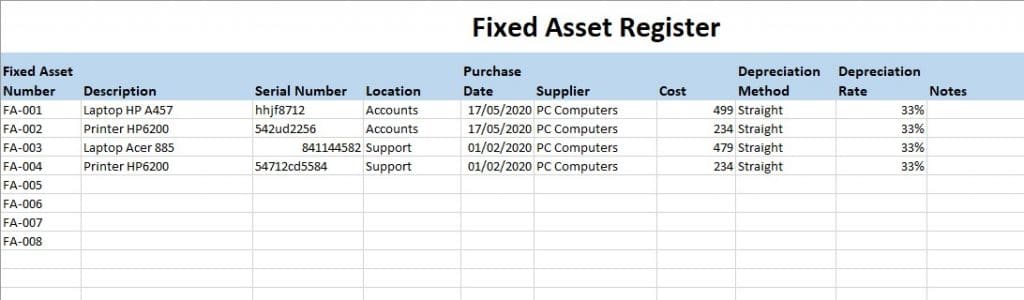
Use Our Free Fixed Asset Register to Track Depreciation
An asset register keeps all your asset information in one place. This helps you apply depreciation consistently and reduces the risk of accounting errors.
Our free register helps you record and manage:
- Asset number, description and serial number
- Purchase date and purchase cost
- Useful life and depreciation method
- Annual depreciation amounts
- Accumulated depreciation
- Net book value
- Asset location and supplier (optional)
Software Depreciation
Specific software packages can calculate depreciation. If you are using accounting software, check whether it has this feature; it may save you time. We have also developed a depreciation schedule, which you can download and use.
Xero has an excellent asset and depreciation feature. When you set up an asset, you can set the depreciation rate. It then calculates it for you and posts the figures to the accounts. It saves keeping separate records.
Is depreciation a cash expense?
No. Depreciation does not involve cash leaving your business. It reflects the cost of using an asset over time, not a payment.
Is depreciation required for small businesses?
The Financial Accounting Standards Board expect businesses to depreciate long-term assets. This keeps accounts realistic and consistent.
What is accumulated depreciation?
Accumulated depreciation is the total depreciation charged on an asset over time.
Related Guides
To explore depreciation in more detail, see these related guides:
- Depreciation Calculator
- Straight Line Depreciation Explained
- Reducing Balance Depreciation Explained
- Fixed Assets in Accounting
- Balance Sheet Depreciation
Return from Depreciation Accounting to Bookkeeping Basics page.
